Charter Deposit - How It Works and How Much It Is
The charter deposit explained: what it is for, how much it costs, how a card hold works and when it comes back. A guide for renters and operators.
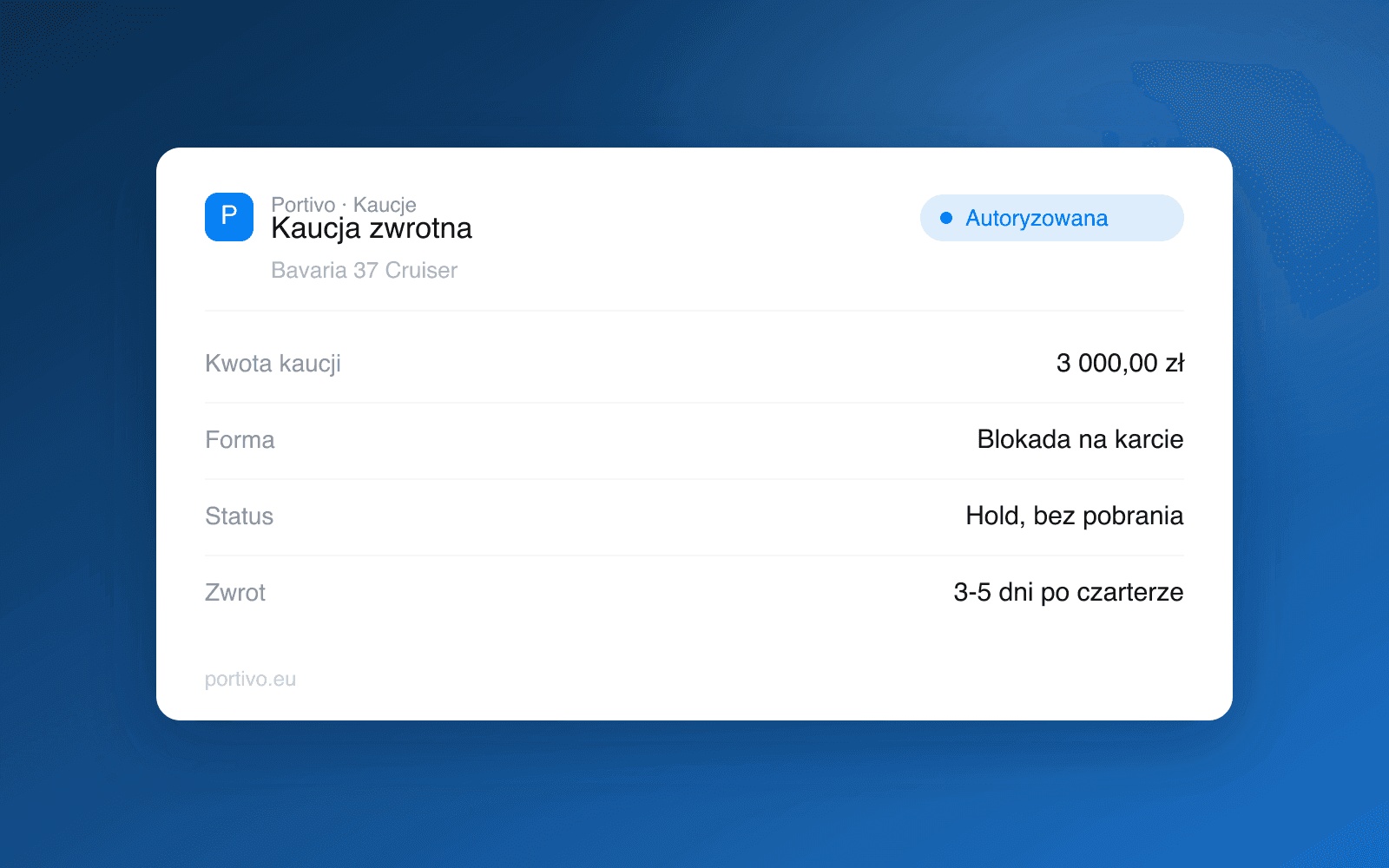
A charter deposit is a refundable security amount the operator takes before the trip in case the boat gets damaged. It is not a rental fee or a hidden cost: if you return the boat without damage, it comes back to you in full. In this guide we explain what the deposit is for, how much it really costs, how a card hold works and when you get your money back. We write from both sides: for the renter who wants no surprises, and for the operator who wants to collect deposits smoothly and without disputes.
Why a charter deposit exists
A boat is an asset worth anywhere from tens to hundreds of thousands of zloty. The deposit gives the operator security in case of damage to the hull, engine or equipment, or if the boat is returned in worse condition than at pickup. For the renter, it is a signal that the boat is genuinely protected and that the after-trip settlement follows clear rules rather than someone's judgment.
The deposit is refundable. That sets it apart from the non-refundable prepayment that confirms your booking, and from service charges such as cleaning or refueling. If you return the boat clean and undamaged, the whole amount comes back to your account.
How much the deposit is
The size of the deposit depends mainly on the value of the boat and the waters. At sea, with larger yachts and catamarans, deposits can run into thousands of euros. On Polish lakes, with houseboats and smaller yachts, the amounts are usually clearly lower. The ranges below are market ranges, not a specific operator's price list, so the final amount is always stated by the operator in the contract.
| Boat type / waters | Indicative market range | Notes |
|---|---|---|
| Houseboat, small motorboat (lakes) | from a few hundred to approx. 2,000 zl | depends on value and season |
| Sailing yacht (lakes) | approx. 1,000-3,000 zl | higher for newer boats |
| Sea yacht, catamaran | from approx. 1,000 to 8,000+ EUR | depends on size and region |
The deposit is not the operator's profit. It is a frozen amount that you get back in full if the boat is returned in a condition that matches the handover report.
How a card hold works
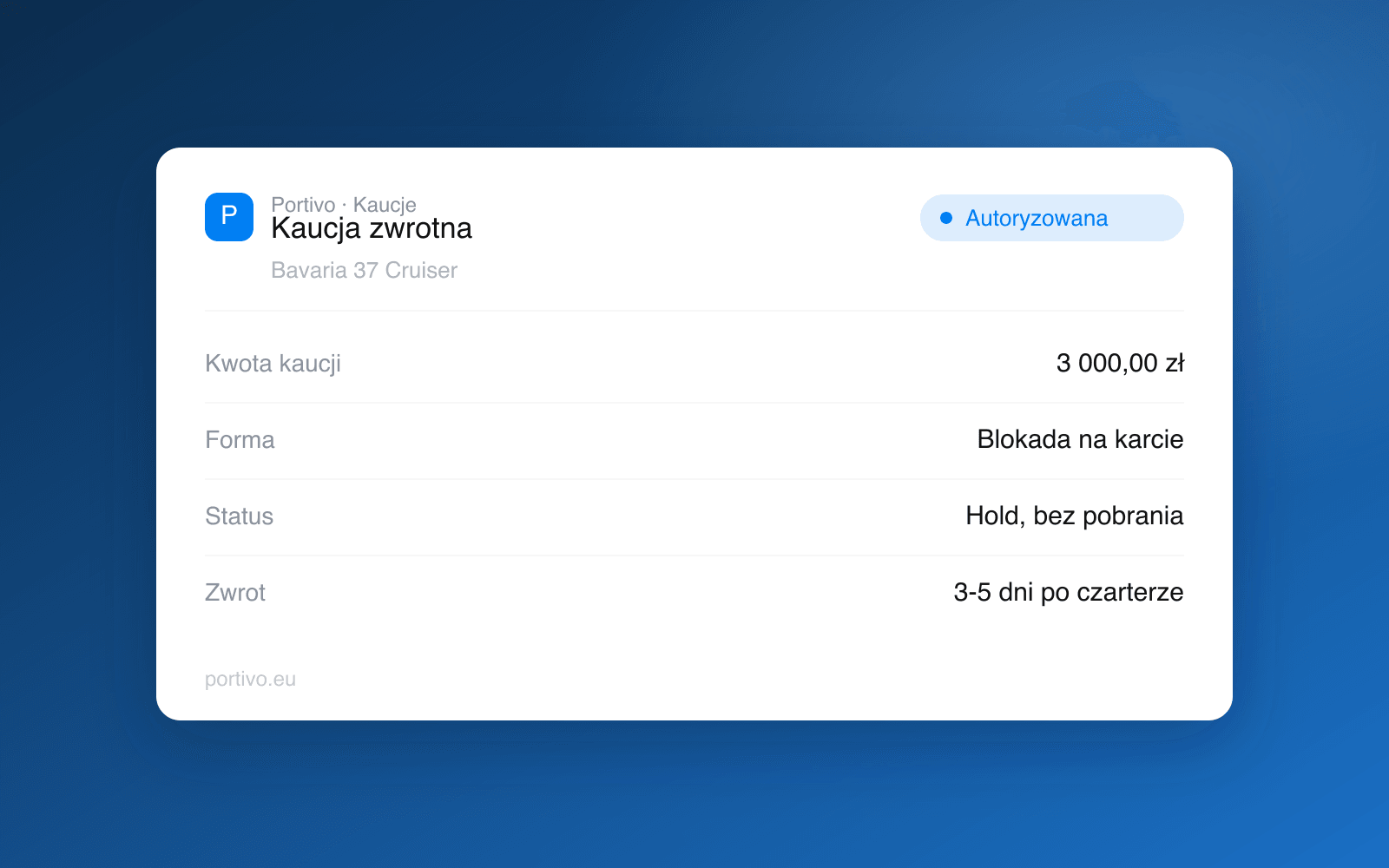
More and more often the deposit is not paid in cash at pickup but placed as a card hold, that is a pre-authorization. The bank reserves the amount on your account but does not charge it: the money stays yours, it just temporarily lowers your available card limit. Once you return the boat without damage, the hold is released and the funds are fully available again. If damage occurs, the operator settles the agreed part of the deposit and releases the rest.
In Portivo the operator sets the deposit collection method once, at policy level, and the system takes over from there. The options are an online card hold or cash at pickup. The deposit is always shown to the customer separately from the charter price, so it is clear what is a fee and what is a refundable security.
When the deposit comes back
With a card hold, the funds are usually released within 3-5 days after the charter ends, once the operator confirms the boat has been returned. With a cash deposit, the refund happens on the spot, right after the boat is inspected. The key here is the handover report: it documents the state of the boat at pickup and at return, so any deduction has a basis and is not one person's word against another's.
If you run a rental company, it is worth combining the deposit with a clear charter payment policy. The prepayment, the balance and the deposit are three different things, and the customer should see them separated at every stage: at booking, in the confirmation and in the booking management view.
The deposit from the operator's side
For an operator, tracking deposits manually is a real risk. A forgotten hold, missing damage documentation, or a cash deposit that was collected and recorded nowhere all end in disputes and losses. Portivo ties the deposit into the rest of the process within one of the system's six modules, alongside bookings, offers, the storefront and handover reports. As a result the deposit is part of the same booking record that holds online payments by card, BLIK, Przelewy24, bank transfer or cash at pickup.
The effect is simple: the customer knows how much the deposit is and when it returns, while the operator has a single trail of events instead of notes in several places. That cuts admin time and reduces room for misunderstanding. For more on how to organize this at fleet scale, see our guide to charter fleet management.
Deposit versus insurance
The deposit and insurance are not the same thing, though they complement each other. Boat insurance covers serious damage but usually has an excess. The deposit covers exactly those smaller damages and the excess, so it acts as the first line of settlement. That is why an operator almost always takes a deposit even for a well-insured boat.
Frequently asked questions
Is the charter deposit refundable?
Yes. The deposit is a refundable security. If you return the boat without damage and in line with the report, it comes back to you in full, usually within 3-5 days with a card hold.
How much is a charter deposit?
It depends on the value of the boat and the waters. On lakes it is usually from a few hundred to a few thousand zloty, at sea from about 1,000 to over 8,000 EUR. The exact amount is stated by the operator in the contract.
How does a deposit differ from a prepayment?
The prepayment is part of the charter price and confirms your booking. The deposit is a separate, refundable security against damage that is returned after the trip. They should be shown separately.
Cash deposit or card hold?
A card hold is more convenient for both sides: the money stays on the customer's account and the operator does not have to count cash. Cash at pickup is still possible if the operator allows it.
When can an operator deduct from the deposit?
Only when the handover report shows damage or missing items beyond normal wear. The agreed part is settled, and the rest of the deposit returns to the customer.
Running a rental company and want to collect deposits online without disputes? See how online payments in Portivo work, check pricing that depends on fleet size or book a meeting.