Digital accessibility for charter websites: what the European Accessibility Act requires
The European Accessibility Act has applied since 28 June 2025. Check whether your online booking website meets the digital accessibility requirements.
Since 28 June 2025, Poland has applied the rules implementing the European Accessibility Act (EAA): an EU directive that imposes accessibility requirements on, among others, e-commerce services. If a customer can book a boat and pay online on your website, you are providing an e-commerce service and these rules apply to you as well, unless you fall under the micro-enterprise exemption. This article explains who is actually covered, what accessibility means in practice for a charter website, and why it is worth providing even when you formally do not have to.
Where the obligation comes from and who it covers
The European Accessibility Act is an EU directive from 2019, implemented in Poland by the act of 26 April 2024 on ensuring accessibility requirements for certain products and services by economic operators. The rules have applied since 28 June 2025. They cover e-commerce services, meaning sales and bookings through a website or app: online shops, booking systems, portals with online payment.
The key exemption: micro-enterprises providing services, meaning companies employing fewer than 10 people with annual turnover up to 2 million euro, are exempt. Most Polish charter companies formally fit that exemption. Before you exhale, though: an exemption from the act is not an exemption from the market. Customers with disabilities, seniors and people booking one-handed from a phone on a pier all use the same forms, and large sales channels keep raising requirements for partners. Accessibility is ceasing to be a legal topic and becoming a standard, like responsive design a decade ago.
What non-compliance can cost
For companies covered by the obligation, the act provides administrative fines: up to ten times the average monthly salary, but no more than 10% of annual turnover. On top of that comes the soft risk: a customer complaint, a negative review and a lost booking, which no regulation will ever price. As with the Omnibus directive, the sensible strategy is not waiting for an inspection but making the requirement part of your website's standard.
Four accessibility principles in booking practice
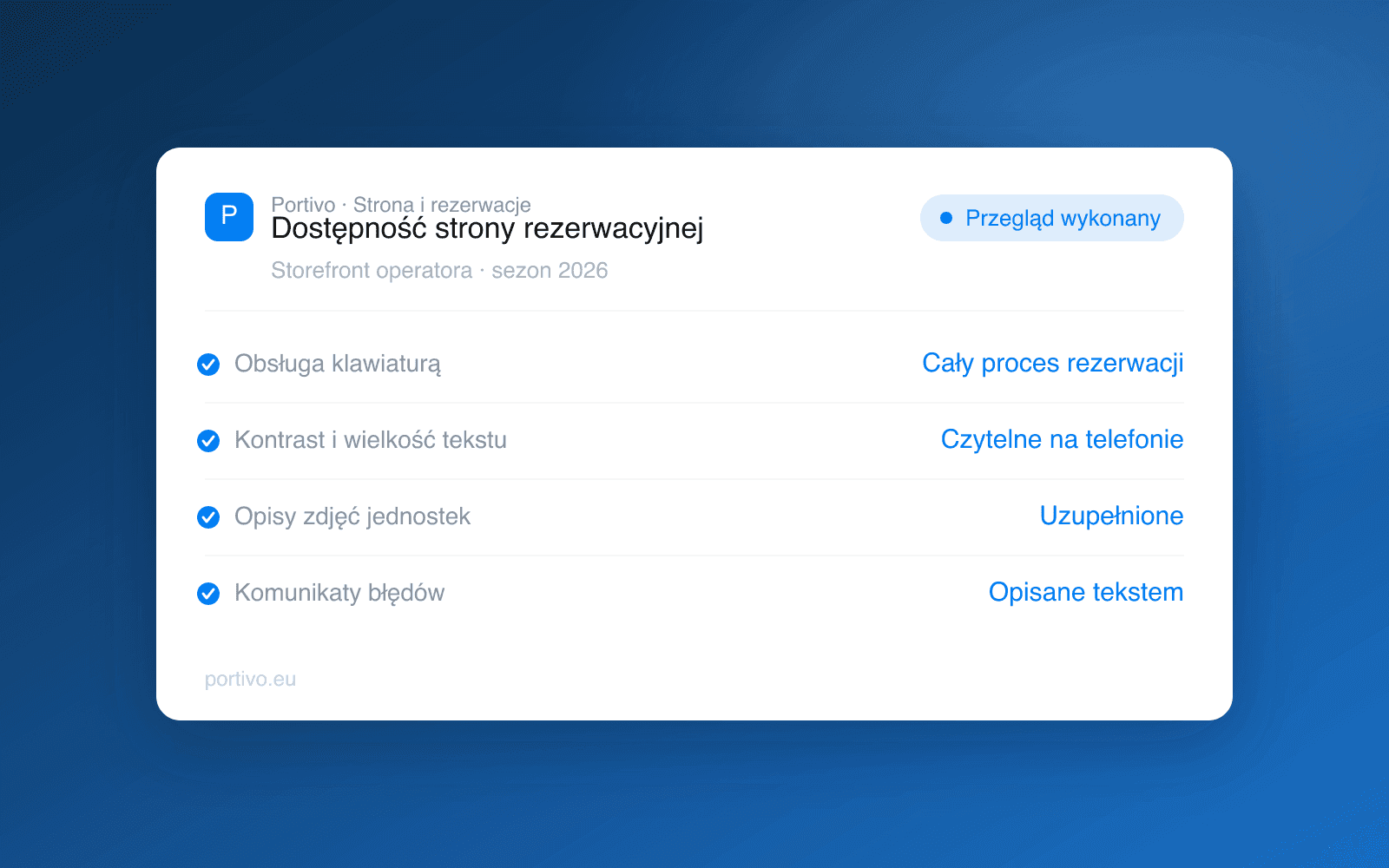
The accessibility requirements come down to four principles known from the WCAG guidelines, which the European technical standard builds on. On a charter website they look like this:
| Principle | What it means on a charter website |
|---|---|
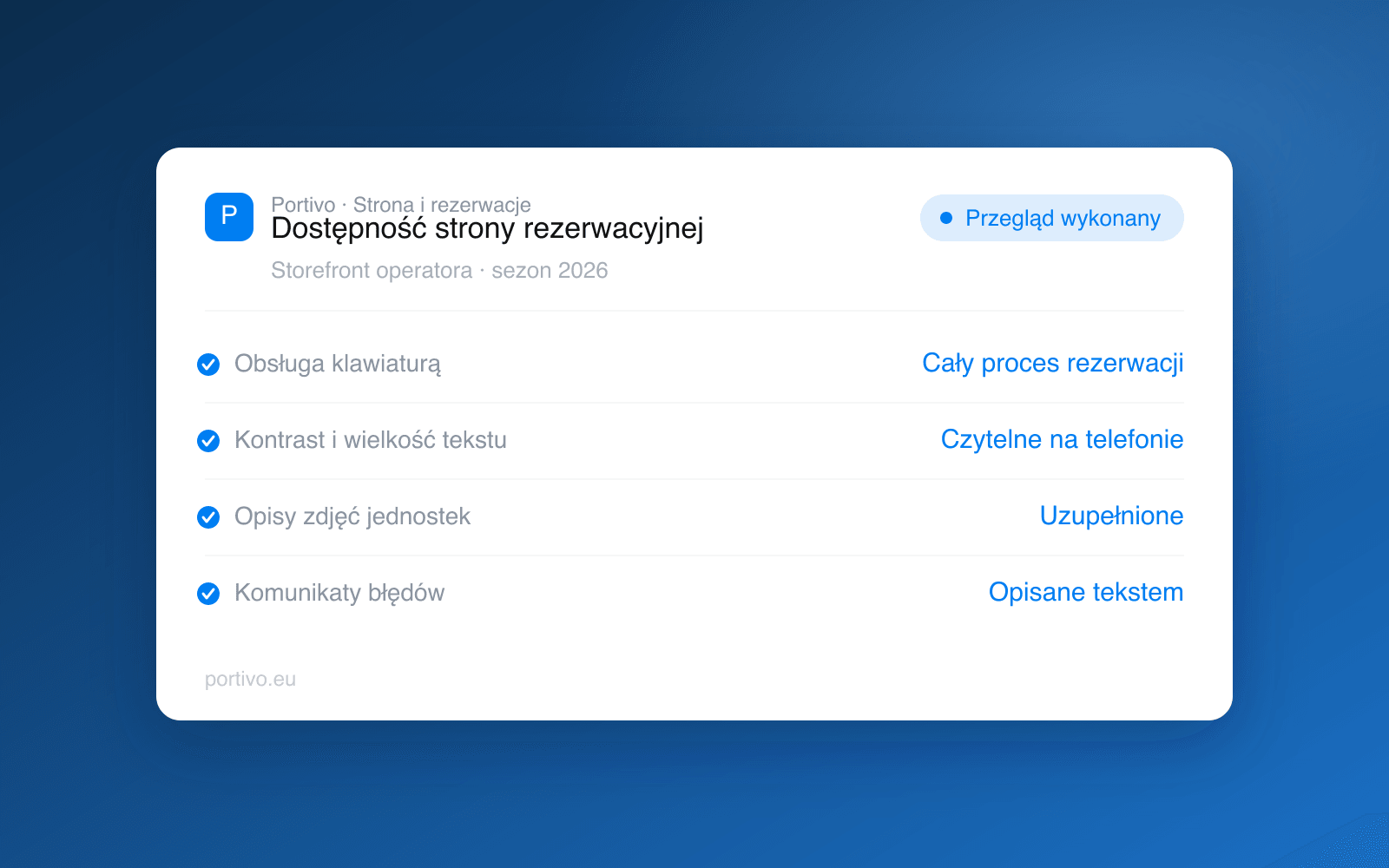
| Perceivable | Boat photos have alternative descriptions, text has sufficient contrast and can be enlarged without breaking the layout |
| Operable | The whole booking flow, from picking a date to payment, can be completed with a keyboard, no mouse |
| Understandable | The form says plainly what went wrong: the error message describes the problem in text, not just a red border |
| Robust | The website works with screen readers and other assistive technologies |
These four principles double as a good audit checklist. Pretend the mouse does not exist and try to book your own boat with the keyboard alone: if you get stuck on the availability calendar or the payment window, you know where the work starts.
Where charter websites fail most often
Three spots come up in audits again and again. First, boat photo galleries without alternative descriptions: to a screen reader such a listing is a string of nameless images, and it is the photos that sell the trip. Second, an availability calendar operable only by mouse, which for some users ends the booking at the date-picking stage. Third, forms with colour-only validation: a red border without a word of explanation. All three problems sit at the heart of the flow we describe in the article on booking a yacht online: if the customer cannot get through these steps, it does not matter how good the offer is.
What the operator gains beyond legal peace of mind
An accessible website is a faster website: correct code, clear headings and described images are the same things search engines reward. It is also a wider customer base: the booking gets completed by a senior, a visually impaired person and anyone tapping a phone in full sunlight. In Portivo, the operator storefront is developed centrally, so accessibility improvements reach all customer websites without separate deployments, delivered as part of the website module. If you are only starting to build your online presence, begin with our guide to a website for a charter company.
Digital accessibility is a process, not a one-off project. Every new subpage, photo and form field can break it, so repeat the review after bigger website changes rather than once per launch.
Frequently asked questions
Since when does the European Accessibility Act apply in Poland?
The rules have applied since 28 June 2025. They were implemented by the act of 26 April 2024 on ensuring accessibility requirements for certain products and services by economic operators.
Does a small charter company have to comply with the EAA?
Micro-enterprises providing services, meaning companies below 10 employees and 2 million euro of annual turnover, are exempt from the act's obligations. It is still worth complying voluntarily: an accessible website serves more customers and ranks better in search engines.
Is online yacht booking an e-commerce service under the EAA?
Yes. If the customer picks a date, books and pays through a website, it is an e-commerce service, a category of services explicitly covered by the accessibility rules.
Which technical standard do you need to meet?
The reference point is the WCAG guidelines, which the European standard for digital accessibility refers to: in practice, level AA is the target. The four principles are perceivable, operable, understandable and robust.
Does the Portivo storefront meet accessibility requirements?
We develop the storefront centrally and systematically improve its accessibility for all operators at once: from keyboard operation to image descriptions. We will show the details at a meeting, and pricing depends on fleet size: see the pricing page.
Want a booking website that keeps up with modern standards without your supervision? See the website module in Portivo and book a meeting.