The Omnibus Directive in charter: how to announce discounts legally
The Omnibus Directive covers services too, so charter promotions must show the lowest price from the last 30 days. See how to announce discounts without fines.
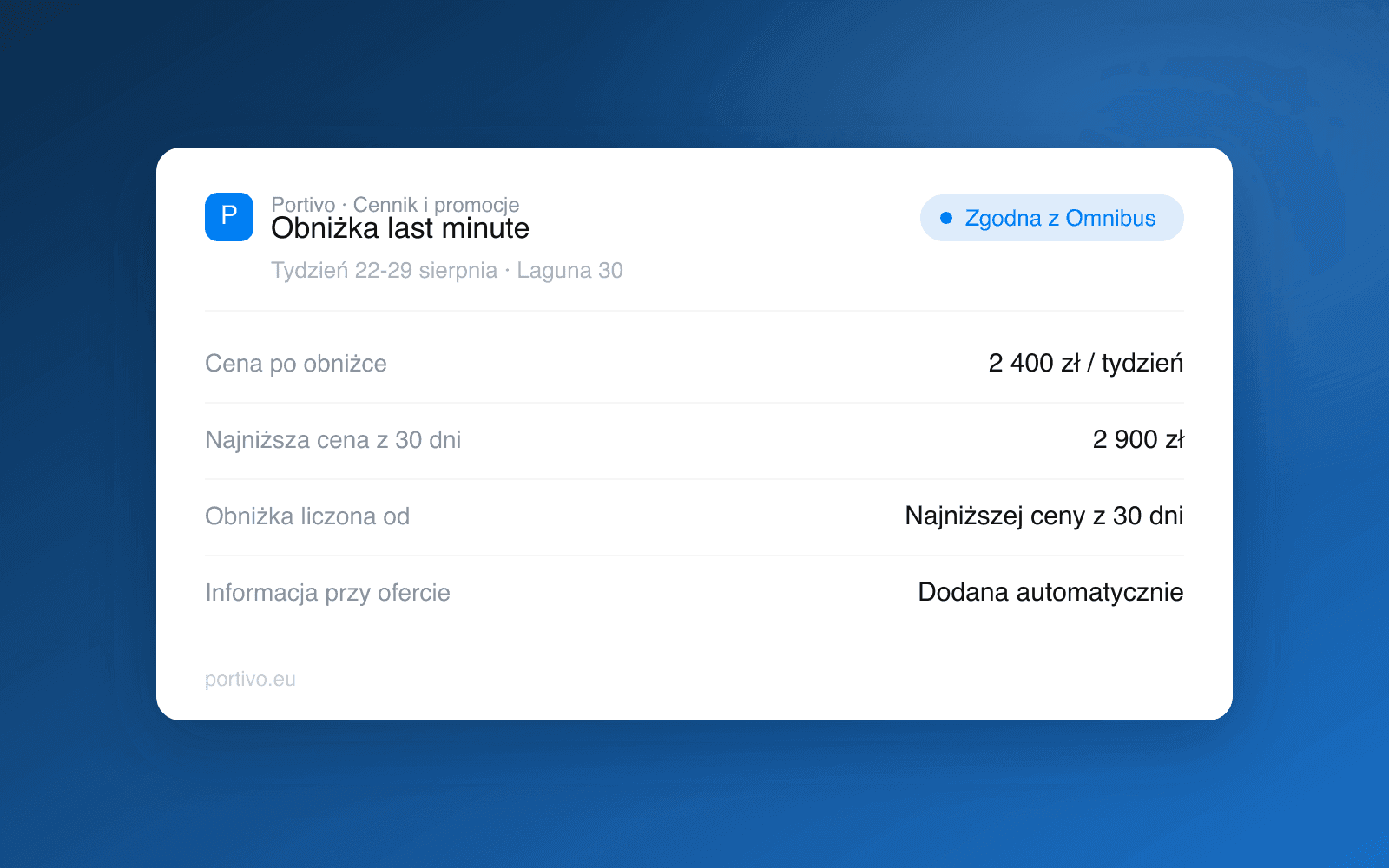
Announcing a "minus 20%" last minute deal on a free week in August? Since 1 January 2023, next to the new price you must show the lowest price of that service from the 30 days before the discount. The Omnibus Directive, implemented into Polish law through an amendment to the price information act, covers goods and services alike, so charters are very much included. Here is when the rule applies to your promotions, how to calculate the reference price and how a discount differs from an ordinary price list change.
Where Omnibus came from and what it is for
The EU Omnibus Directive was created to end fake promotions: raising a price two weeks before a "great discount" back to its pre-rise level. The mechanism is simple: since every announced discount must display the lowest price from the last 30 days, artificially pumping the price up before a promotion stops working, because the customer sees it in black and white.
For a charter operator this is not a rule "for online shops". The obligation applies to every business announcing a price reduction for a good or a service, regardless of whether it sells through its own website, a listing portal or over the phone after announcing the promotion on social media.
When the rule applies to you, and when it does not
The key distinction: Omnibus is triggered by announcing a discount, not by every price change. A seasonal price list where a September week is cheaper than an August one is not a promotion but a price structure; the same goes for dynamic pricing reacting to occupancy, as long as you do not market it to customers as a "discount" or "promotion". A "last minute -20%" banner, a discount code for all your followers or a marked-down specific date on your site are, however, classic discount announcements.
| Situation | Does Omnibus apply | Why |
|---|---|---|
| "Last minute -20%" banner on the website | yes | public announcement of a service price reduction |
| Discount code in a newsletter for everyone | yes, as a rule | a general, announced discount, not a 1:1 offer |
| Seasonal pricing: September cheaper than August | no | price list structure, no discount announcement |
| Price changes from dynamic pricing | no, as long as not marketed as a promotion | ongoing price setting, not an announced discount |
| A discount negotiated individually with a client | no | a personalised offer, not a public announcement |
This table is practical guidance, not legal advice: borderline cases (discount tiers, loyalty programmes, bundles) are worth checking with a lawyer, especially if you turn them into a permanent sales channel.
How to calculate the lowest price from 30 days
The reference price is the lowest price at which the service was offered during the 30 days before the discount was announced. Three practical consequences for charter:
- You calculate per offer, not per fleet. The lowest price concerns the specific service: the same boat type and a comparable date, not the cheapest yacht in the company's history.
- An offer younger than 30 days (a new boat, a date newly on sale): you show the lowest price since it went on offer.
- You calculate the discount percentage from the reference price. If a week cost 2 900 zł, then 2 600 zł, and you now announce 2 400 zł, the reduction against the lowest 30-day price (2 600 zł) is about 8%, not 17% off the original price.
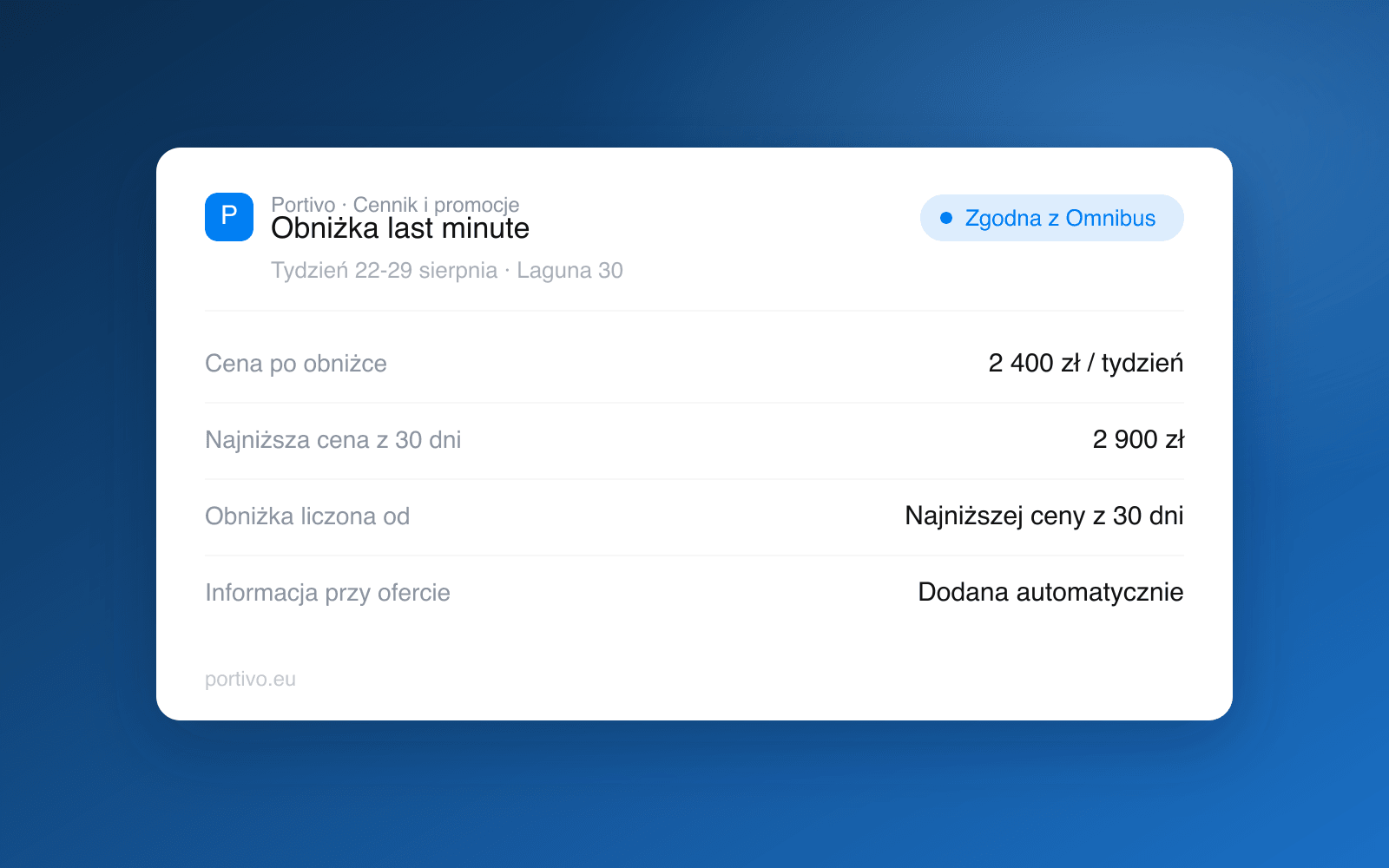
A condition that is easy to forget: the lowest-price note must accompany every announced discount, meaning everywhere you communicate it: on the offer page, in the last minute mailing, in the promo post. If your booking site generates prices from a price list but you apply the promotion by hand in three places, mistakes come easily; with your own website with online booking wired to a single price list, the note attaches itself to the offer in every channel from the same source.
What you risk for missing the note
For incorrect discount information the Trade Inspection can impose a fine of up to 20 000 zł, and up to 40 000 zł for a third violation within 12 months. A separate, more serious front is the consumer protection office UOKiK: practices violating collective consumer interests carry fines of up to 10% of annual turnover. In a business where the season makes most of the revenue, even the lower bracket hurts more than fixing a banner would have.
It is also worth remembering that Omnibus is part of a wider consumer rights package: withdrawal rules and the operator's information duties are collected in our article on consumer law in charter.
Omnibus versus vouchers and last minute
Two charter-specific cases. First: selling vouchers. If you announce a voucher promotion ("buy in November 10% cheaper"), the information duty works as for any service: you show the voucher's lowest price from 30 days. Second: last minute. Selling free dates cheaper is not the problem; the problem is marketing it as a discount without a reference price. Practical advice: since you are discounting anyway, show the lowest 30-day price openly, because an honestly calculated last minute reduction usually still looks attractive.
The most common operator mistake is a "promotion" calculated from a catalogue price nobody could actually book at in the past month, because dynamic pricing went lower long ago. For the consumer office this is a textbook example of misleading practice. The reference point is the lowest price from 30 days, not the catalogue price.
FAQ: the Omnibus Directive in charter
Does Omnibus cover services or only goods?
Both. The Polish rules on announcing price reductions cover goods and services, so yacht charter, houseboat rental and extra services fall under them just like selling equipment.
Do I have to show the lowest price at every price list change?
No. The obligation concerns announced discounts, meaning messages like "promotion", "discount", "X off". An ordinary price list change, seasonality and dynamic prices without a discount announcement do not trigger the duty.
How long do I need to keep price history?
The rule requires showing the lowest price from the 30 days before the discount, so the minimum is a running price history of every offer from the last month. In practice a system that logs price changes automatically removes the problem entirely.
Does a regular client's discount fall under Omnibus?
A discount negotiated individually or granted to a specific person is not a public discount announcement. The line runs through communication: the same discount announced to all "regular clients" in an open channel starts to look like a public promotion.
Want to promote free dates without legal roulette at every banner? See how the Bookings module keeps price lists and price history in one place, or book a call: we will show you how operators structure promotions in line with the rules.