Yacht breakdown on a charter: what to do step by step and who pays
A yacht breakdown on a charter does not have to end your cruise. See what to do step by step, when the owner pays for repairs, and what happens to your deposit.
A yacht breakdown on a charter looks scary, but in practice it follows a simple script: secure the crew and the boat, call the operator, and do not repair anything on your own without their approval. Who pays for the repair depends on the cause of the fault and the contract terms, which is why documentation from the first minutes matters more than a wrench in your hand. Below is the whole process step by step, from reporting the fault to settling the deposit.
Crew first, yacht second
Before you start thinking about costs, make sure nobody is in danger. If the engine dies in the middle of the waterway, drop the sails or anchor, put on life jackets and get off the fairway if possible. A steering or rigging failure in strong wind is a situation where you head for the nearest safe shore, not for your destination port. We collected the rules for handling rough conditions in our guide to safety on the water.
Step by step: from fault to repair
| Step | What you do |
|---|---|
| 1. Secure | Crew in life jackets, yacht at anchor, on a buoy or alongside |
| 2. Identify symptoms | What stopped working, since when, what happened just before |
| 3. Call the operator | The number is in your contract and in the boat documents |
| 4. Wait for instructions | No repairs on your own without the owner's approval |
| 5. Document | Photos, a short note, the time you reported the fault |
| 6. Confirm arrangements | Service visit, replacement boat, or continuing with limitations |
The most common mistake is step 4. Taking the engine or the electrical system apart yourself can turn a minor fault into serious damage, and shift the financial responsibility onto you, even if the original cause was on the owner's side.
Who pays for the repair
The rule is simple: whoever is at fault pays. If the fault comes from wear and tear, a hidden defect or earlier neglected servicing, the owner covers the costs. If the damage was caused by the crew, for example running aground or wrapping a mooring line around the propeller, the repair is usually covered from the deposit. The exact split is defined by the contract, so it pays to know what to check in a charter contract before signing, and we explain how the hold and refund work in our article on the charter deposit.
There is also a third scenario: damage that exceeds the deposit. This is where the boat's insurance comes in, usually liability and hull insurance with an excess. How the policy works and what it does not cover is described in our guide to charter yacht insurance.
Document everything from the first minute
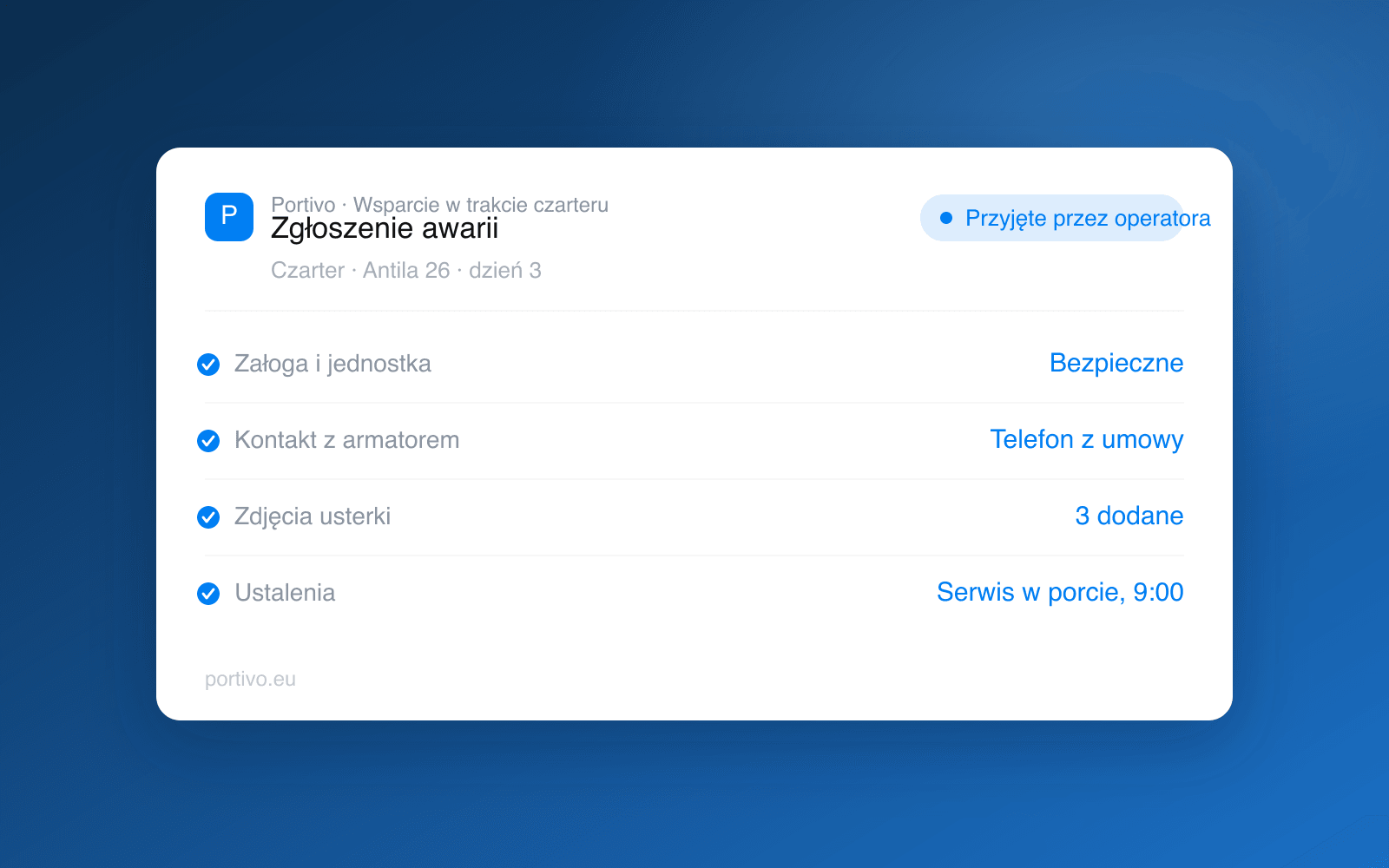
Take photos of the fault and its surroundings, note the time of the report and what you agreed on the phone, ideally in a short message to the operator so there is a record. With operators running a modern system, the boat's condition at handover is described in a photo-based handover protocol, so it is easy to separate pre-existing faults from new ones. This protects both sides: you will not pay for earlier neglect, and the owner has a basis for settling real damage.
Replacement boat, shortened cruise, refund
If the breakdown makes further sailing impossible for reasons on the owner's side, the options are a replacement boat, a repair within a reasonable time, or a refund for the lost days. The specifics depend on the contract, so before booking check whether it covers this scenario at all. Professional operators, whom you can find on Portivo, have an emergency procedure spelled out and a duty phone for the duration of the charter, and in practice that makes a bigger difference than the prettiest photos in a listing.
If this is your first cruise and you are still learning how the whole process works from booking to returning the boat, have a look at our first charter guide.
Frequently asked questions
Can I fix a minor fault on the yacht myself?
Not without the owner's approval. Even for a small thing, call first: the operator knows the boat and will tell you whether you can act yourself or whether they will send a technician. An unauthorized repair can shift the costs onto you.
Does an engine failure mean the end of the charter?
Usually not. Most faults are fixed by the service team in port within hours. For a more serious failure caused by the owner's side, a replacement boat or a refund for the lost days comes into play, depending on the contract.
Do I lose the deposit with every breakdown?
No. The deposit covers damage caused by the crew, up to the amount set in the contract. Faults resulting from wear and tear or hidden defects of the boat are the owner's responsibility, not yours.
What if the damage exceeds the deposit?
Then the boat's insurance kicks in, usually hull insurance with an excess. In practice you are most often liable up to the deposit or the excess, unless the damage was caused by gross negligence.