Registering a yacht in REJA24: who it covers and what a charter company reports
Yacht registration in REJA24 covers boats longer than 7.5 m or with engines above 15 kW. Who must register, what document you get and what operators report.
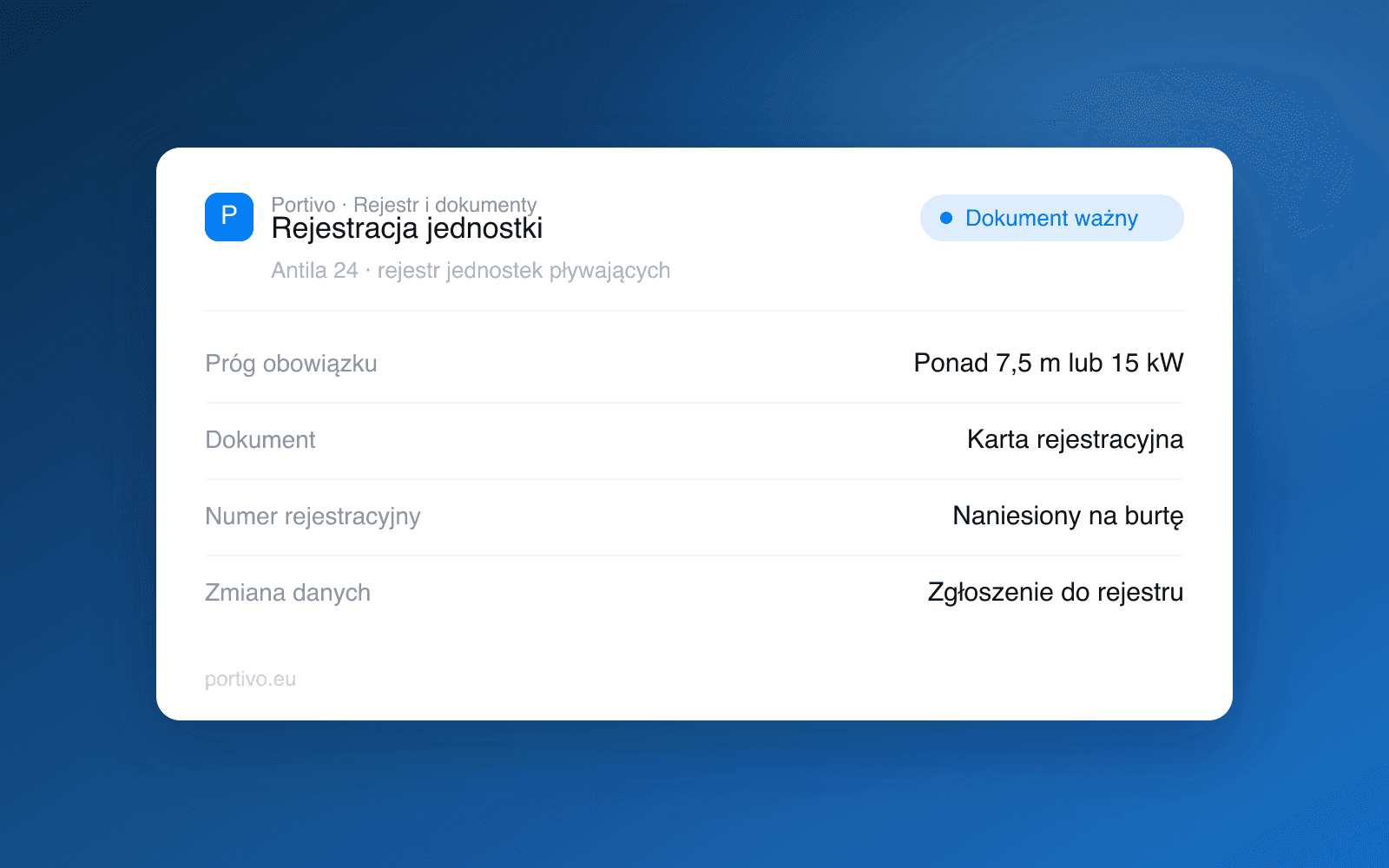
Since 1 August 2020, every yacht and other vessel up to 24 metres in Poland goes into a single national register kept in the REJA24 IT system. It replaced the scattered registers previously run by various bodies and, along the way, changed what the vessel document looks like and where you file the application. For a charter company this is not administrative trivia, it is a piece of fleet documentation that the insurer, the authorities and increasingly the customer ask about.
Who must register
The obligation covers vessels up to 24 metres intended for or used in sport, recreation or fishing. In practice it comes down to three cases.
| Vessel | When registration is mandatory |
|---|---|
| A yacht or a recreational fishing vessel | Length over 7.5 m or a mechanical drive above 15 kW |
| A yacht or other vessel in international voyages | Always, regardless of length and engine power |
| A vessel used for commercial fishing | Always |
The length and power thresholds work independently: crossing either one makes registration mandatory. A small motorboat with a powerful engine is covered exactly like a long sailing yacht with a weak auxiliary.
Vessels below the thresholds can be registered voluntarily at the owner's request. For a charter company that can be convenient, because the registration document also serves as clear proof of ownership.
Who does not have to register
Excluded are vessels driven solely by human muscle, surfboards and sailboards, and vessels intended exclusively for regattas and sporting competition, provided they hold a racing class and a valid certificate issued by the competent sports federation. The same goes for racing rowing boats. Kayaks, pedalos and boards in a rental fleet therefore usually need no register entry, unlike chartered yachts and larger motorboats.
What you get after registration
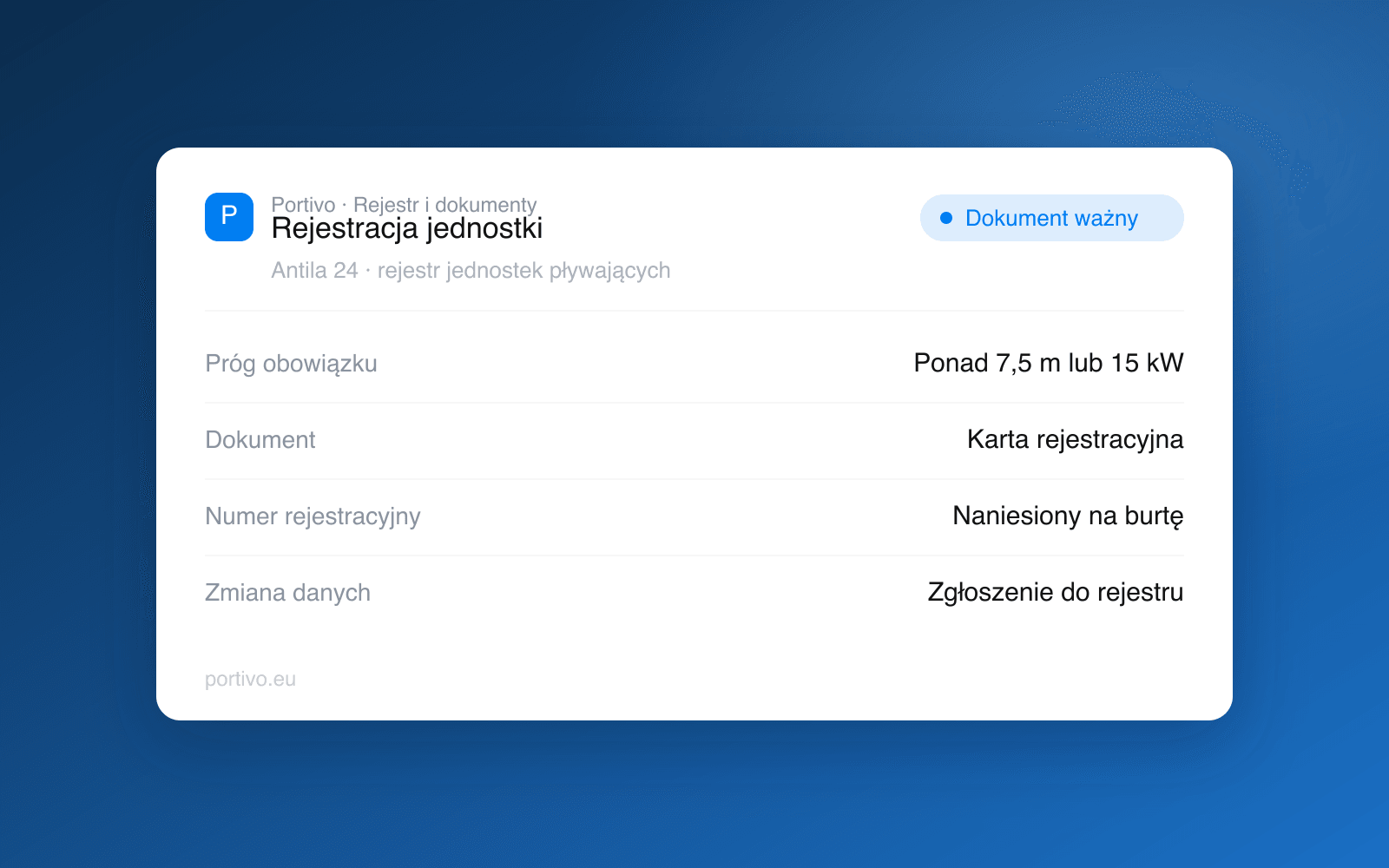
The procedure ends with a registration document issued as a plastic card. That document is both proof of ownership and confirmation of the vessel's Polish nationality, which matters when sailing outside the country. The card is collected from the registering authority, and the application can be filed with any authority you choose: the register is shared, so neither your place of residence nor the home port decides. Registration, de-registration and data updates are also available as e-services in the register portal.
What it means for a charter company
For a fleet operator, registration comes down to three practical things.
First, a complete set of boat documents. The registration card, the insurance policy and the survey should sit in one place and be at hand at every handover, not in a binder in the office. How we keep documents attached to the boat record is described in the guide to insuring a charter yacht, and the boat's history together with protocols is kept by the Protocols module.
Second, keeping the data current. A change of owner, a conversion, swapping in a more powerful engine or selling a boat after the season are events reported to the register. The engine swap is a trap: a vessel previously outside the obligation may fall under it once the power goes above the threshold.
Third, the moment you start the business. Registering the boats is one of the first items on the formalities list when launching a fleet, next to insurance and pricing. We set out the full list in the guide to starting a charter company.
Selling a boat and taking it out of the fleet
A charter fleet changes: every few seasons one boat goes up for sale and a newer one takes its place. A sale is a register event, so alongside the sales contract and handing over the documents you need to update the owner data in the register. De-registration and data updates are available as e-services, so no visit to an office is required.
A good moment to review the paperwork of the whole fleet is the end of the season, when you are planning surveys, servicing and winter storage anyway. That is when you can see which boat's policy is expiring, which one is waiting for a survey and whose register data stopped being accurate after changes on board. How to spread those tasks across the off-season, we described in the guide to winter storage and closing the season.
What it means for the customer
A customer chartering a yacht registers nothing: that is the owner's duty. It is worth knowing, though, that the boat documents should be on board and that you can ask for them at handover, just like for the manual and the safety equipment. Vessel registration is entirely separate from crew qualifications: the licence requirement comes from different rules, and we described the thresholds in the guide to chartering without a licence.
If you run a fleet and want documents, survey dates and boat history in one place alongside bookings, book a meeting: we will show what a boat record looks like in practice.
Frequently asked questions
Does a 6-metre yacht need to be registered?
No, as long as its mechanical drive does not exceed 15 kW and it does not make international voyages. The thresholds work independently, so a short boat with a powerful engine is already covered.
Where do you file the registration application?
With any registering authority you choose, because the register is shared nationwide. Registration, data updates and de-registration are also available as e-services in the register portal.
What document does the owner receive?
A registration document in the form of a plastic card. It is proof of ownership and confirms the vessel's Polish nationality.
Does registering a boat replace a sailing licence?
No. Registration concerns the vessel, a licence concerns the qualifications of the person in charge. They are two independent matters governed by separate rules.