Charter company visibility in AI: how to end up in assistant answers
Customers ask AI assistants about charters before they open a search engine. See which company data must be public so the AI has something to recommend.
More and more customers start planning a cruise with a question put to an AI assistant rather than with a list of search results. "Where can I rent a yacht in Masuria for a week in August, for four people, without a licence" is now a perfectly normal query, and someone gets a ready answer with a few company names in it. If your company is not there, the reason is usually mundane: the model had nowhere to take any specifics about you from. Here is what actually decides whether you show up in those answers.
Why AI skips most charter companies
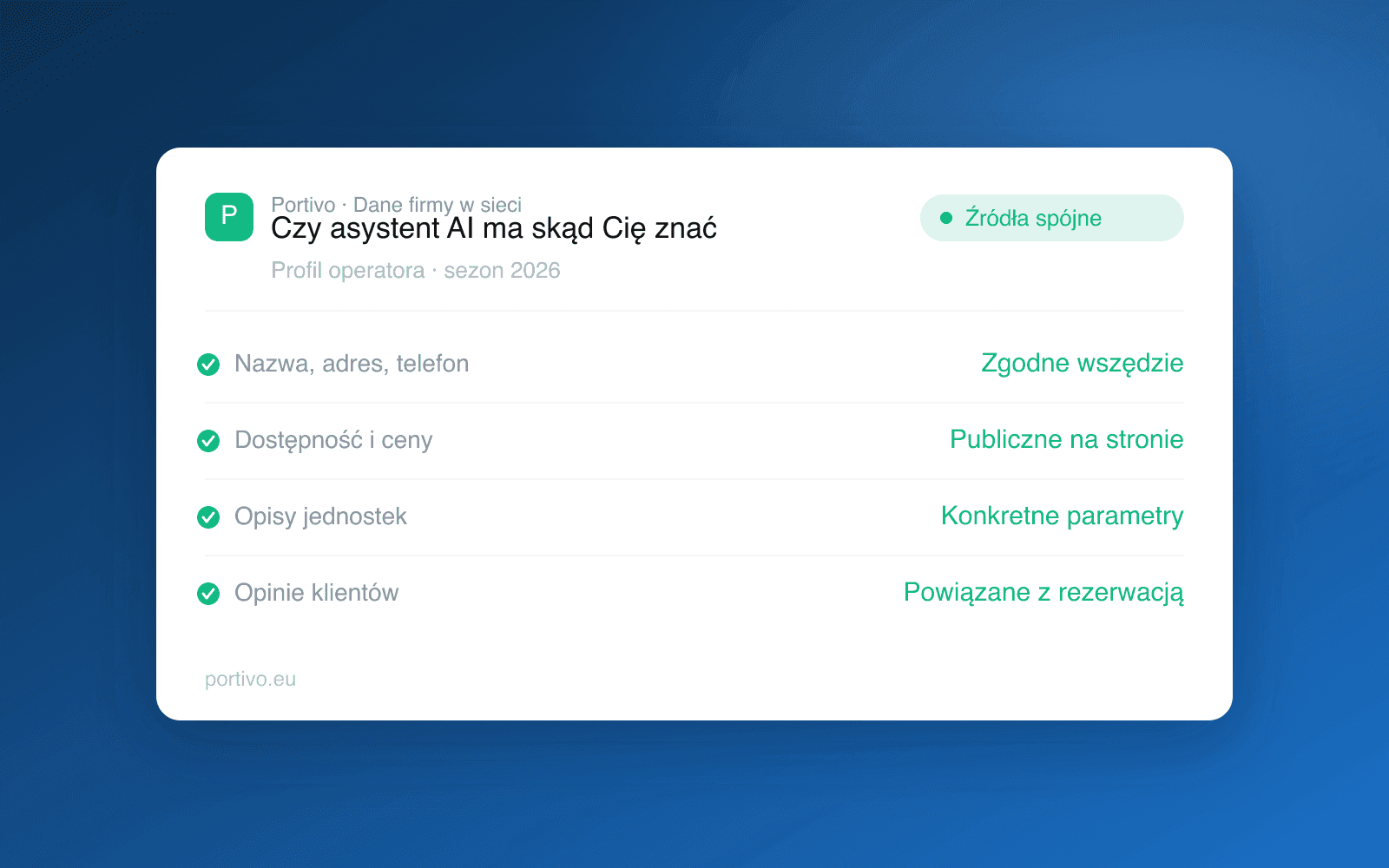
An assistant builds its answer from content it can read and verify. A typical operator website has three problems here. First, the most important information sits inside graphics or PDF price lists. Second, availability and prices hide behind an "ask for a quote" form, so there is nothing concrete on the page to cite. Third, the company details differ between the website, the maps listing and directory profiles, so the model cannot be sure who it is talking about.
The result is that portals and aggregators win the answers, because they publish parameters, dates and price ranges as text. We described the same mechanism when writing about direct bookings: whoever hands information over to intermediaries hands the customer over too.
What has to be public for AI to recommend you
| Element | What to do | Why it works |
|---|---|---|
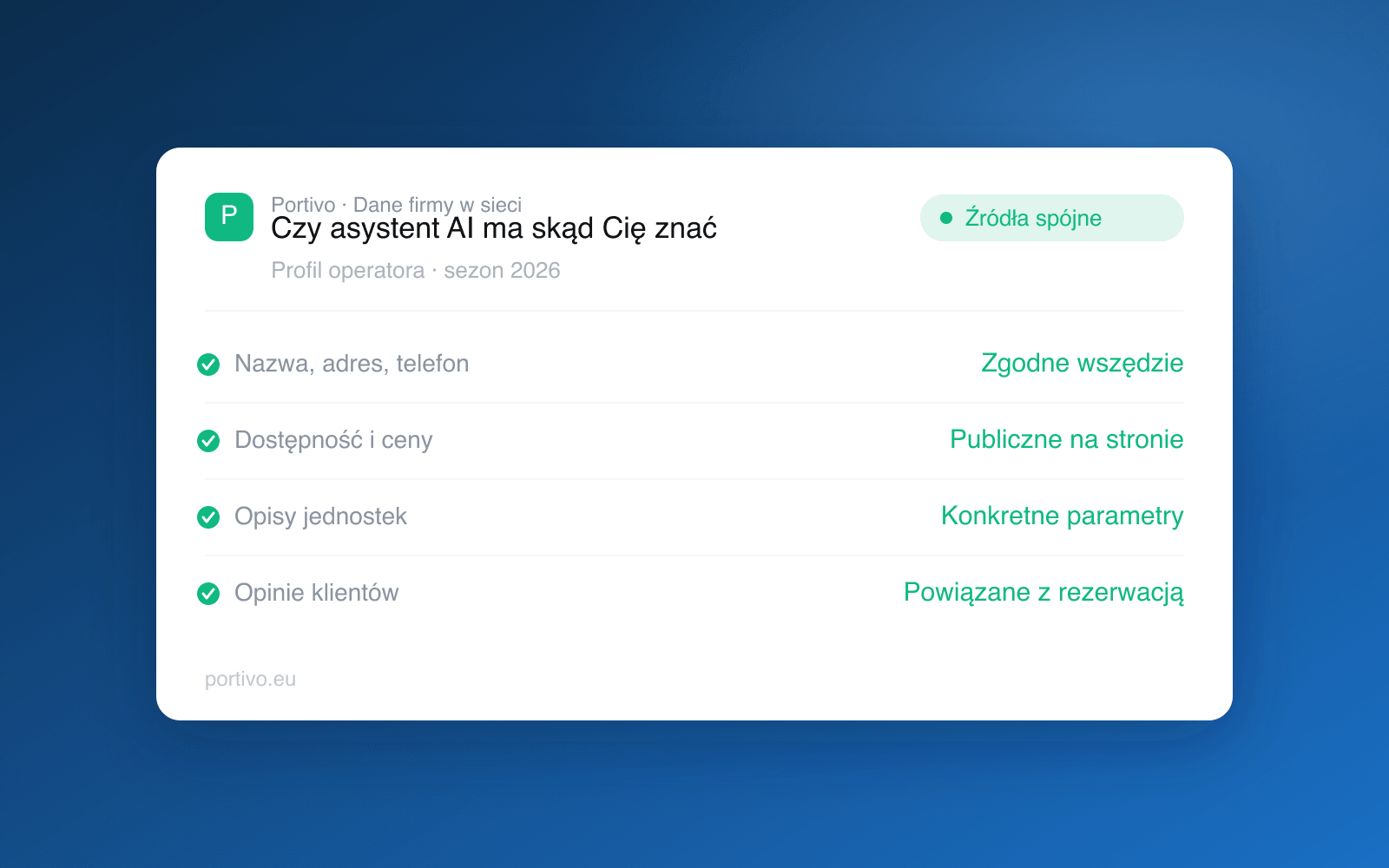
| Company details | The same name, address and phone on the site, in maps and in directories | The model merges scattered mentions into one company |
| Fleet | A separate page per boat with parameters written as text | Answers questions about berths and length directly |
| Availability | A calendar of free dates accessible without logging in | Gives a concrete answer instead of "ask for a quote" |
| Prices | Ranges or seasonal rates described in text | Lets the answer match the budget stated in the question |
| Rules | Deposit, formalities and licence requirements stated plainly | These are the questions customers ask assistants most often |
| Reviews | Reviews linked to real bookings, visible on the site | A credibility signal that directories cannot replace |
Write so that you can be quoted
An assistant's answer is assembled from fragments of text, so pages written in short, self-contained chunks win. Instead of a paragraph about "years of experience and a passion for sailing", state it plainly: how many boats are in the fleet, where the base is, what the charter dates are, how much the deposit is and which licences are needed. A questions and answers section on the fleet page works better than one long "About us" page, because each block answers a single question.
Three things worth doing this week:
- List the questions customers ask most and answer them on the site, one paragraph per question. The raw material is in your inbox and your chat history, as we wrote when covering customer communication.
- Pull the specifics out of graphics. Write boat parameters and seasonal rates as text and tables, not as a photo of a price list.
- Tidy up the boat descriptions so each one carries the length, number of berths, engine, equipment and required licences.
The technical layer: structured data and crawler access
Beyond content, it matters whether the site can be read by a machine at all. The basics: schema.org structured data for the business and the offer, correct headings, sensible page addresses, no content rendered only after a user interaction, and a robots file that does not block assistant crawlers. It also pays to have a site fast enough that a crawler does not hit a timeout. This is the same work that improves ordinary search rankings, so it is not an investment in a single channel. How to build such a site without an agency or an in-house team is covered in the article on a website for a charter company, and the ready-made set comes with the Website module.
Test yourself: ask an AI assistant the question your customer would ask and see what comes back. If it names other companies, read their pages and compare how many specifics they carry in text. The difference usually is not the budget, it is that they publish numbers while you ask for a phone call.
Reviews and mentions beyond your own site
A model is more willing to name a company it has read about in several independent places. That is why it pays to keep an up to date maps listing, maintain profiles in industry directories and collect reviews from customers after every cruise. The most credible ones are tied to a specific booking, because it is clear they come from real charterers. We break the whole process of collecting and publishing reviews down in the article on customer reviews in a charter company. And if the customer can also book and pay with you straight away, the path from the assistant's answer ends with a booking rather than another email: that is how online yacht booking works.
FAQ: a charter company in AI answers
Do I have to publish prices for AI to recommend my company?
You do not need to publish a full price list, but without any concrete figure it is hard to appear in an answer to a budget question. Ranges or seasonal rates written as text are enough, along with a note on what affects the price.
Is a maps listing enough on its own?
No. A listing helps confirm the company exists and where it is based, but answers about dates, boats and charter rules are built from the content on your own site.
How quickly does it show?
This is a matter of months, not days: models draw on content indexed earlier as well as live web searches. The change shows fastest where you add a specific that was previously nowhere on the web.
Does this replace search engine optimisation?
No, it complements it. The same elements, a clear structure, concrete content and structured data, improve both search rankings and your chances of being cited by an assistant.
Want your offer to be readable both by customers and by AI assistants? Book a short meeting: we will show you how to publish your fleet, availability and reviews in Portivo so they can be found and booked right away.