Online payments for charters: cards, BLIK and instalments that police themselves
Online charter payments: card, BLIK, Przelewy24 and bank transfer in one booking flow. How self-policing advances and balance payments lift sales and save time.
A customer who wants to pay for a charter and cannot is a customer who will shortly pay someone else. Yet a large share of Polish charter companies still sell the way they did a decade ago: an email with an account number, a bank transfer "within 3 working days" and a booking left hanging. Online payments reverse that flow: the customer books and pays in one session, and the system polices the balance payments itself. Here is how it works and what it changes in an operator's numbers.
Why the traditional bank transfer loses bookings
A customer planning a cruise compares several operators at once, usually in the evening, after work. If with you they can only send an enquiry and wait for an account number, while at your competitor they click "book and pay", the statistics are merciless: the winner is whoever lets them close the deal on the spot. Every hour between "I want it" and "paid" is a window for the booking to escape.
Then there is the manual work: checking bank statements, matching transfers to bookings, chasing balance payments. The Portivo landing page speaks of a promise of 70% less time on administration; the mechanism is simple: what you do not do by hand does not eat your season.
Which payment methods are worth offering
In Portivo the customer pays the way they pay everywhere else on the Polish internet:
| Method | When it works best |
|---|---|
| BLIK | the fastest path on a phone, natural for domestic customers |
| Payment card | foreign customers and bookings far ahead, also the deposit as a hold |
| Przelewy24 | customers used to fast bank transfers |
| Traditional bank transfer | company bookings and customers who need a proforma invoice |
| Cash at handover | only as a balance paid on site, never as the sole booking option |
The point is not to pick one method, but to make sure the customer never drops off at the "I have no way to pay" stage.
What the flow looks like for the customer
A well-arranged payment flow is boring, and that is exactly the point:
- The customer picks a unit and dates in the calendar on your site.
- The system prices the booking from the seasonal price list, extras included.
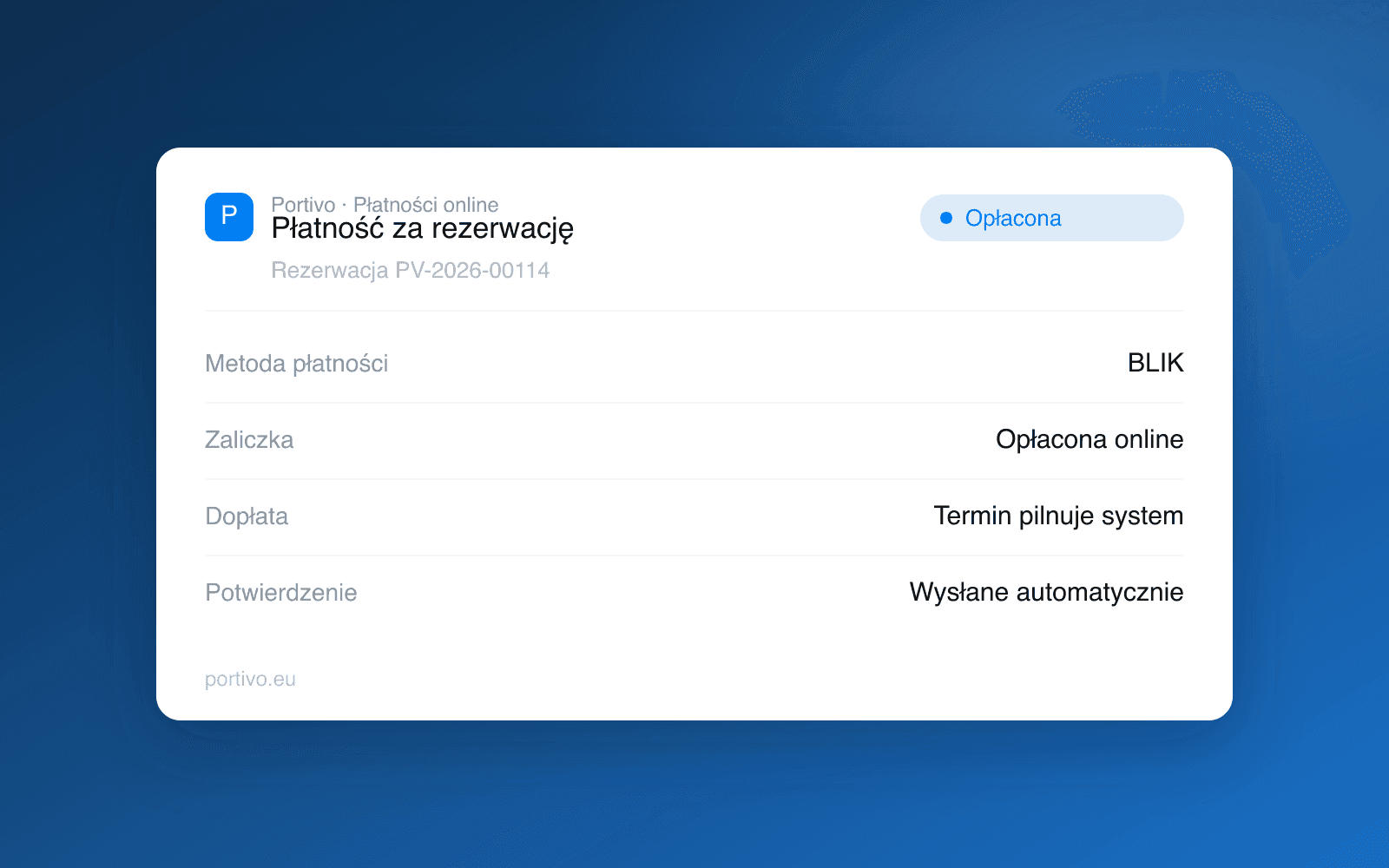
- The customer pays the advance by BLIK or card in the same session.
- The booking changes status; the confirmation and the contract go out automatically.
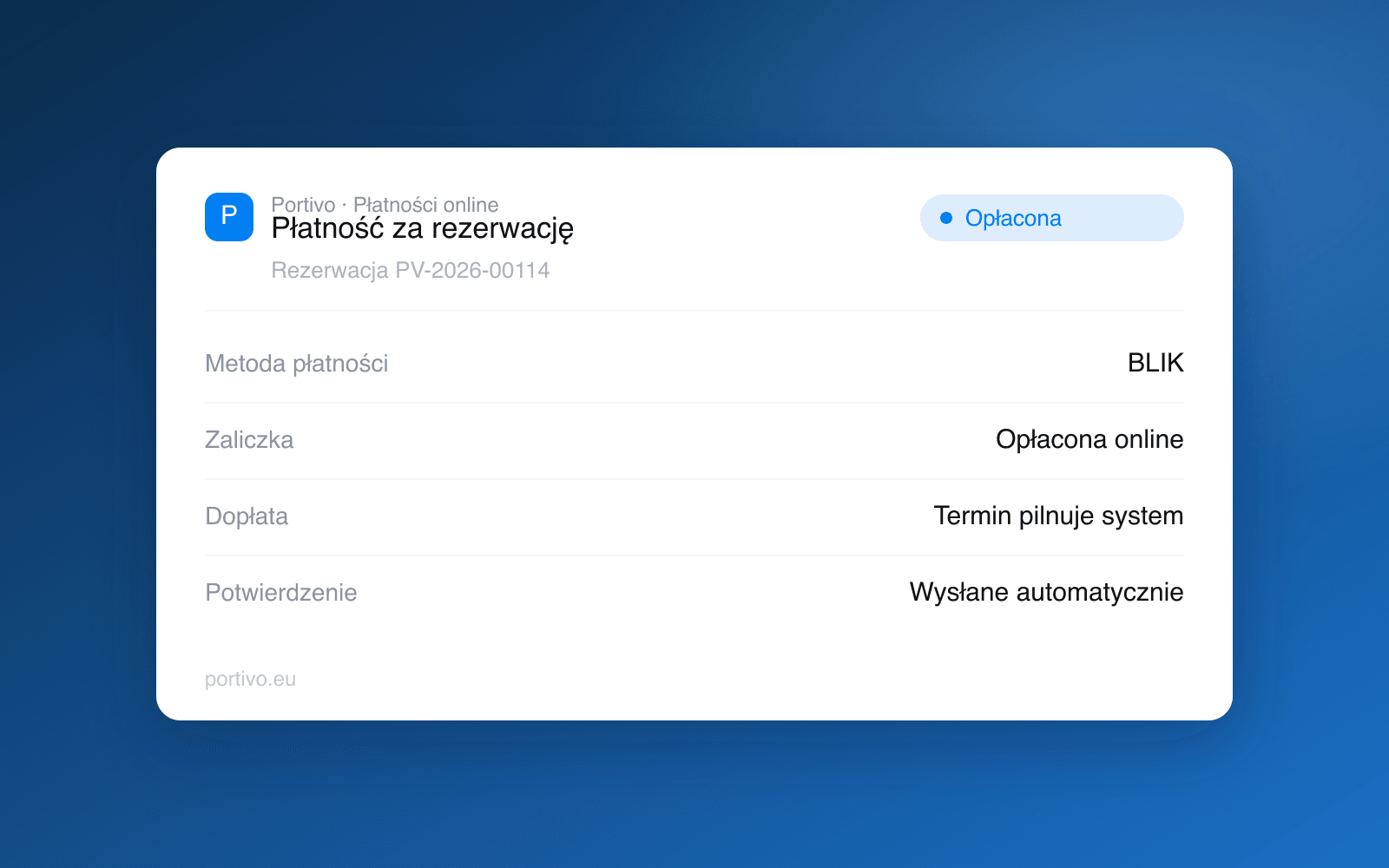
On the operator's side nothing happens, and that is the whole point: no checking the account, no rewriting amounts, no "has my payment arrived?".
Advance, balance, settlement: the payment policy does the work
Online payment is not just a "pay" button. The real leverage sits in the payment policy: what percentage upfront, when the balance is due, what happens after the deadline. You set it once and the system applies the rules to every booking: it sends balance reminders and flags overdue bookings. How to match thresholds and deadlines to your fleet is laid out in our post on charter payment policies.
The security deposit is a chapter of its own: instead of a wad of cash at the dock you can use a card hold that releases automatically after a damage-free return. The whole mechanism is described in our post on the charter security deposit.
What it changes in the numbers
- Higher conversion: the customer closes the booking immediately instead of dropping out in the gap between the email and the transfer.
- Less work: no more matching transfers or manual reminders; everything is visible in one panel next to the booking.
- Better cash flow: advances land instantly and balances arrive on time, because the system watches the deadlines, not your memory.
- Fewer misunderstandings: every payment is tied to its booking; the customer and the operator see the same settlement state.
Payments are just one link in an automated process that runs from the enquiry through confirmations to documents. The full picture is in our post on booking automation, and the module's capabilities are on the online payments page.
Frequently asked questions
Which payment methods does Portivo support?
Card, BLIK, Przelewy24, traditional bank transfer, and cash at handover as an on-site balance. The customer picks the method during the online booking.
Can customers still pay in cash?
Yes, but as a balance at handover, not as the only form. An advance paid online at booking time protects you from empty slots left by no-show customers.
What happens when a customer misses the balance deadline?
The system sends reminders and flags the booking as overdue, according to your payment policy. The decision to cancel or extend the deadline always stays with you.
How much does enabling online payments cost?
Payments are part of the Portivo platform, and pricing depends on fleet size and is confirmed at a meeting. Book a short call and we will walk through the flow on the example of your fleet.