Complaints in a charter company: how to handle customer claims
Charter complaints from the operator's side: 14 days to respond, evidence from handover protocols, fair remedies and a process that saves reviews.
A complaint after a charter is not an accident at work but a fixed part of the season: with dozens of trips a year there will always be a fridge that stopped cooling, an engine that would not start, or a boat cleaned worse than the listing promised. The difference between a company that loses reviews over complaints and one that builds trust on them is not the number of claims but the process behind them. This guide shows how to structure that process: deadlines, evidence, decisions and communication.
A complaint is a procedure, not an argument
The first mistake operators make is treating every claim as an attack. A customer reporting a broken fridge usually does not want a free trip: they want someone to take the problem seriously. That is why every claim should follow a fixed path: one intake channel, a confirmation of receipt, an owner and a decision deadline. If complaints arrive once by email, once by text and once in a conversation on the pier, none of this works and some claims simply get lost. How to structure customer touchpoints across the whole booking journey is covered in our guide to customer communication in charter.
The statutory deadline: 14 days, and silence works against you
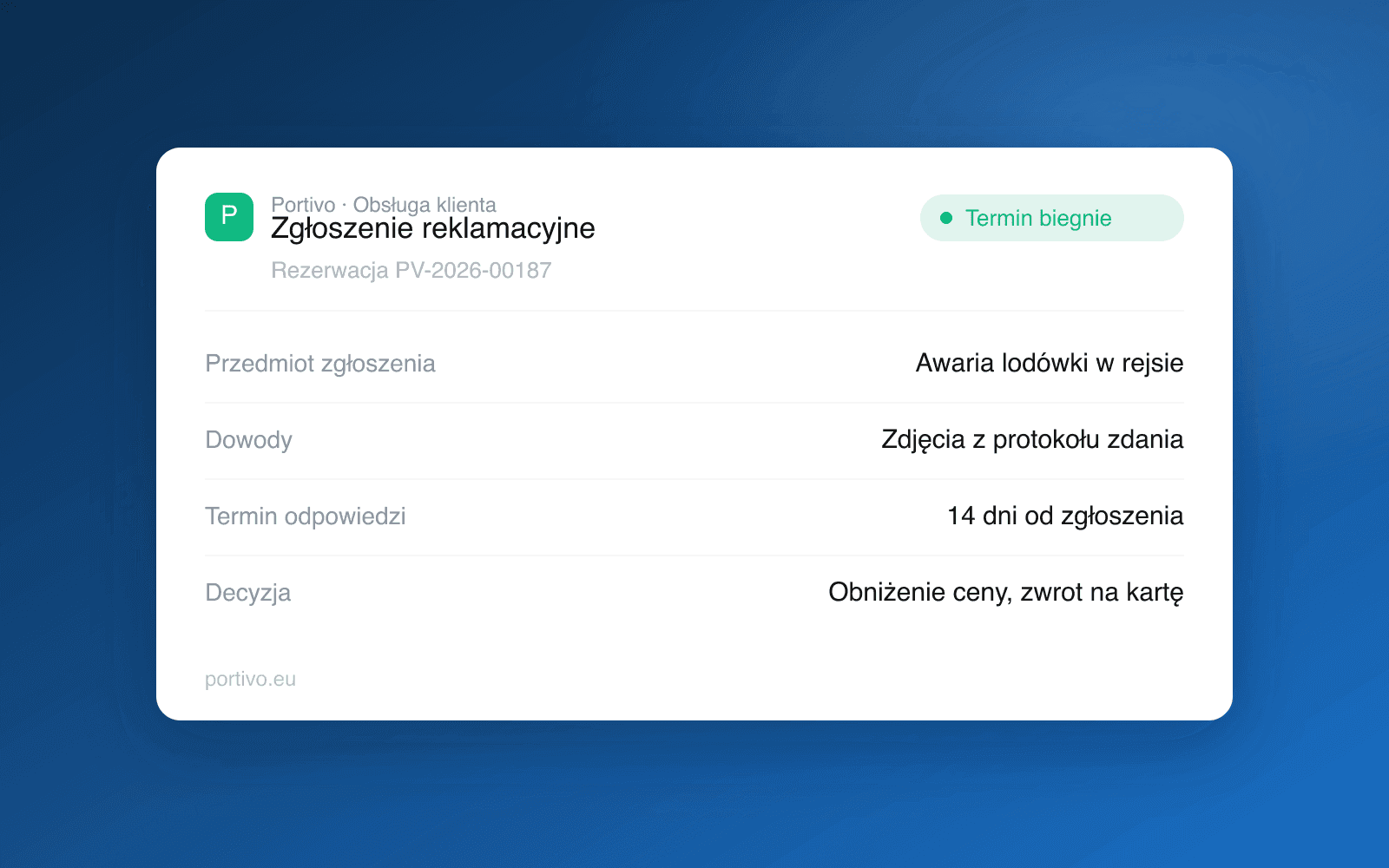
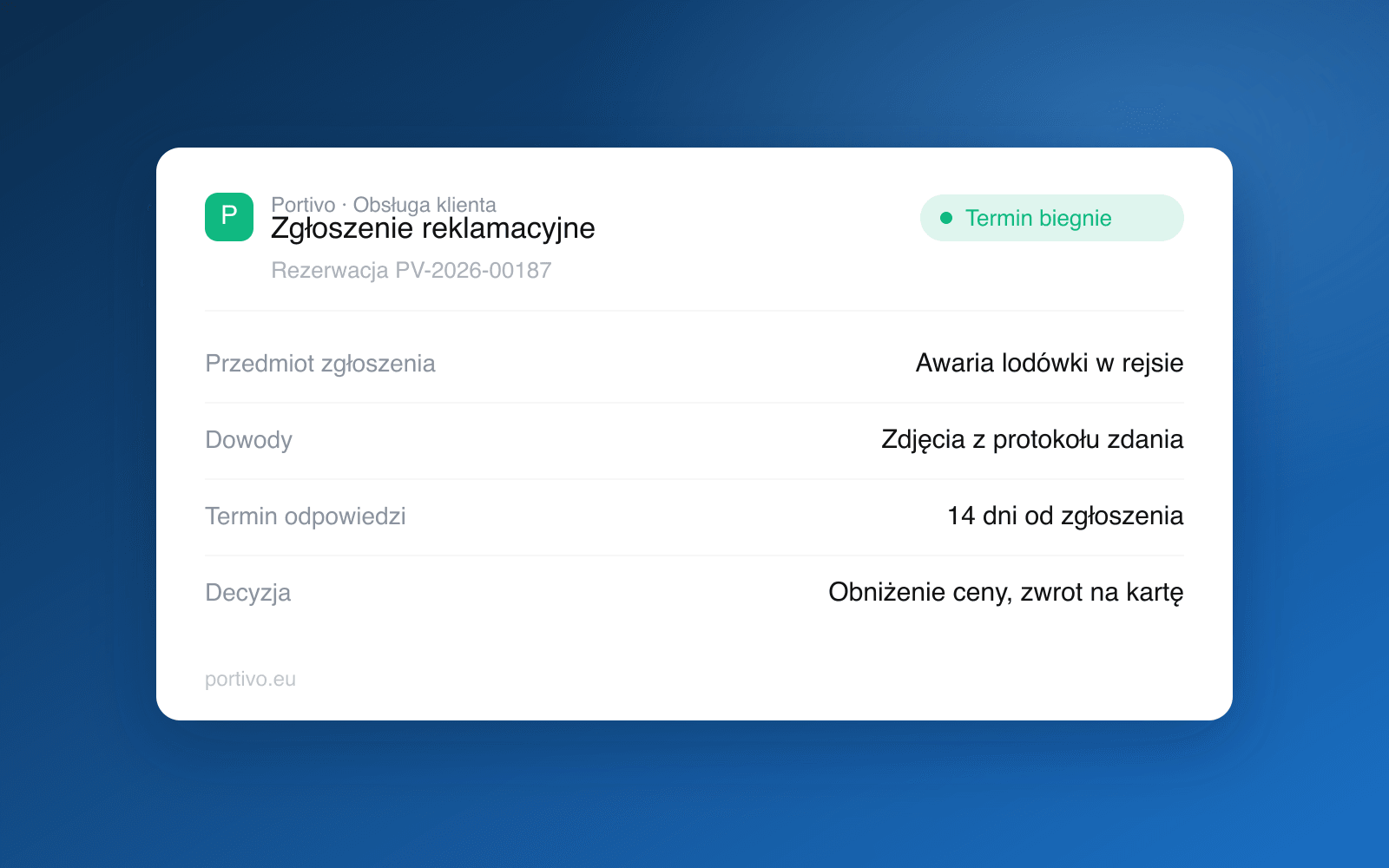
Polish consumer law gives a business 14 days to respond to a consumer complaint. This is not a courtesy deadline: if you do not reply in time, the complaint is deemed accepted in full, together with the customer's demand. In mid-August, when you are handing boats over and back day after day, two weeks fly by, so every claim's deadline must be visible in your system rather than in the owner's memory. The wider picture of consumer obligations, including withdrawal rules, is covered in our article on consumer law in charter.
Evidence: the handover protocol settles disputes
The hardest complaints are those where the customer's word stands against the operator's. Documentation of the boat's condition settles them: a handover and return protocol with photos and both parties' signatures. If the fridge worked at handover and that is on record, you are discussing a mid-trip breakdown, not a boat handed over in poor condition. If the scratch on the hull is in the handover photos, you do not deduct it from the deposit. A digital yacht handover protocol does double duty here: it protects the customer from unfair deductions and the operator from unfounded claims. In Portivo, protocols are one of the system's six modules and attach directly to the booking, so complaint evidence lives in one place, in the protocols module.
The handling process step by step
| Step | What you do | Deadline |
|---|---|---|
| Intake | Confirm receipt and tell the customer when to expect a decision | Immediately, ideally automatically |
| Fact-finding | Gather evidence: protocols, photos, service history, crew accounts | 1-3 days |
| Decision | Accept, accept partially or reject, always with reasoning | 14 days from the claim at most |
| Fulfilment | The refund, discount or compensation reaches the customer | Without delay after the decision |
For refunds, stick to one rule: return money the same way the customer paid. If the booking was paid by card, BLIK or Przelewy24, the refund goes back to the same source, which shortens discussions and leaves a clean accounting trail.
Typical claims and fair remedies
Equipment failure during the trip is the most common case: the fair remedy is a quick repair on the trail and, where that is impossible, a discount proportional to the lost comfort. What to do operationally when a boat breaks down mid-week is covered in our article on yacht breakdowns during charter. The second type is a mismatch with the listing: the customer booked the boat from the offer and got a different unit or poorer equipment. Here the decision should be generous, because the root cause is your communication, not bad luck. The third type is weather complaints: a rainy week is not a defect of the service and such a claim can be rejected, but it is worth doing with class, for example by offering a discount on an off-season trip.
Do not buy silence. Refunding money in exchange for deleting a negative review can violate review platform rules and undermines the credibility of all your ratings. A public, factual reply and a fairly handled complaint work better.
A complaint as an investment in reviews
A well-handled complaint comes back to you as a review: customers describe how the company reacted to a problem more often than the problem itself. A reply within a day instead of two weeks, a concrete decision and a refund without begging are signals future customers read too. How to collect reviews systematically and turn them into bookings is covered in our guide to customer reviews in a charter company.
Frequently asked questions
How long does a charter company have to respond to a complaint?
14 days from receiving a consumer's claim. No response within that period means the complaint is deemed accepted as demanded by the customer, so every claim's deadline belongs in your system, not in a paper calendar.
Can a customer complain about the weather or their own skills?
Weather conditions and the crew's lack of experience are not defects of the service, so such a claim can be rejected. Still, reply factually and with reasoning, because future customers read your answers too.
What if the customer demands a full refund over a minor fault?
The customer's demand does not bind the operator as to the amount: you can accept the claim partially and offer a discount proportional to the inconvenience. What matters is the reasoning behind the decision and meeting the 14-day response deadline.
How does a complaint differ from a deposit deduction?
A complaint is the customer's claim against the operator; a deposit deduction is the operator's claim against the customer. Both disputes are settled by the same documentation: handover protocols with photos from handover and return.
Does a booking system help with complaints?
Yes, because it keeps the booking, payments, protocols and correspondence in one place, so you decide on evidence rather than memory. Portivo's pricing depends on fleet size: see the pricing page or book a meeting.
Want to handle claims on evidence instead of guesswork? See how handover protocols work in Portivo and book a meeting.