Charter Boat Running Costs: What Eats an Operator's Margin
What it really costs to keep a boat in charter: berthing, insurance, winter storage, servicing and hidden costs. How to calculate the result per boat.
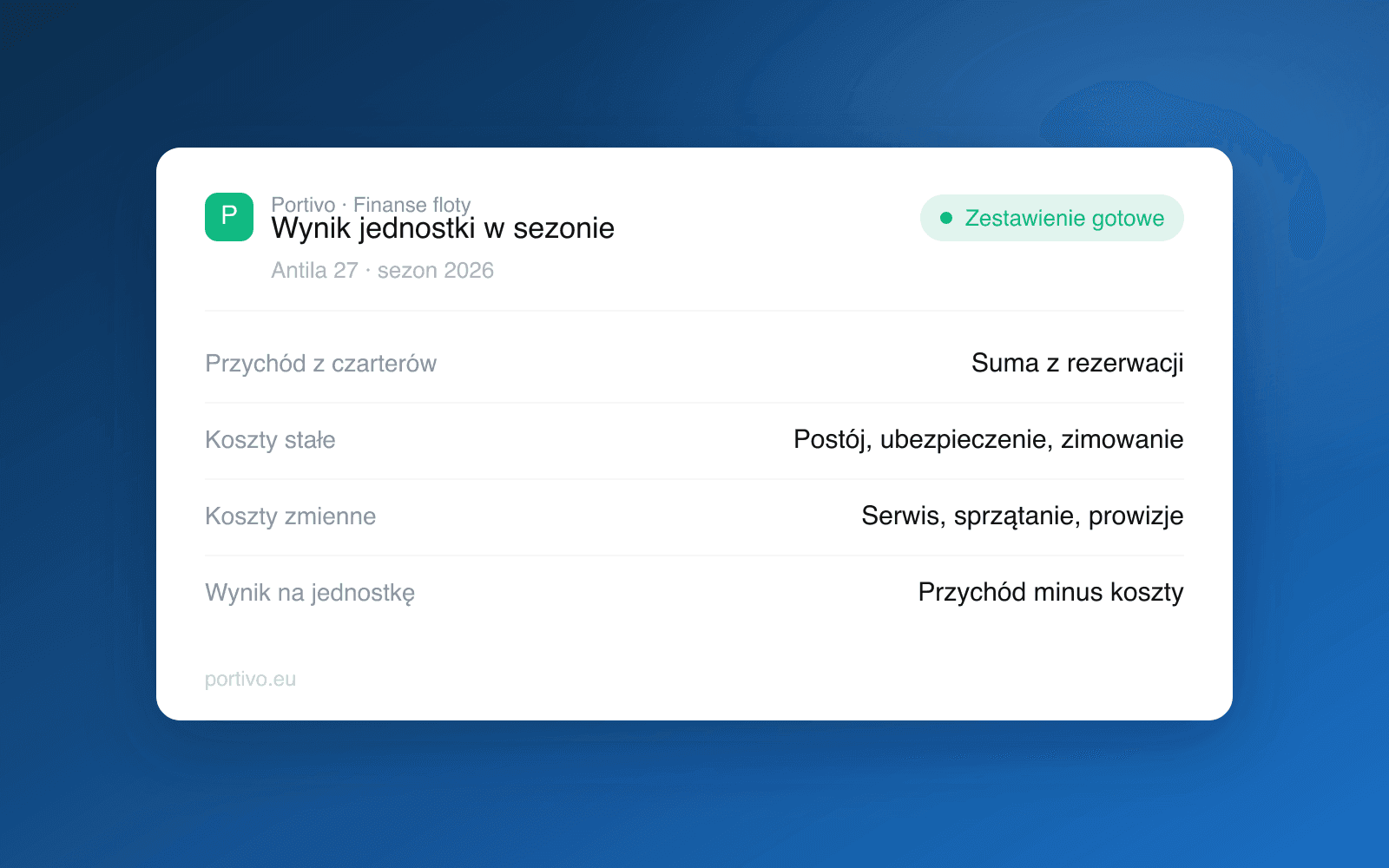
Most operators know their fleet's revenue down to the last zloty and at the same time cannot say which boat actually earns and which one is still in the business out of inertia. The reason is simple: revenue is visible in bookings, while costs scatter across the year over invoices from the marina, the workshop and the insurer. This guide sorts out the cost structure of a charter boat and shows how to calculate the result per boat, instead of looking at the bank balance in October.
Fixed costs: you pay them regardless of how many charters run
Fixed costs are the ones that keep running even if the boat sits at the jetty all season: the marina berth, insurance, winter storage and surveys, and the lease or loan instalment if the boat was financed. The ranges below are observed market rates, not Portivo's pricing or any guarantee: they vary a great deal by region, boat size and marina standard.
| Item | Typical market range | What it depends on |
|---|---|---|
| Marina berth | several hundred to several thousand zloty a month | region, boat length, port standard |
| Insurance (liability + hull) | a few percent of the boat's value a year | value, scope, excess, claims history |
| Winter storage and season prep | from several to over a dozen thousand zloty a year | slip, hall or hardstanding, scope of shipwright work |
| Surveys and technical servicing | depends on engine hours | age, drive type, season intensity |
We break down the scope and real cost of a policy in our guide to charter yacht insurance, and end-of-season work in our guide to winter storage for a yacht.
Variable costs: they rise with the number of charters
The second group depends directly on how many times the boat goes out in a season. It covers cleaning and turnaround between charters, fuel (if the customer does not settle it), wear on gear and bedding, minor repairs after incidents, sales channel commissions and payment processing costs. The paradox is that high utilisation raises these costs and yet almost always improves the result: fixed costs are then spread over more charter days. This is why a boat sailing 12 weeks a season can be more profitable than an identical boat sailing 6 weeks at a higher rate.
How to calculate the result per boat
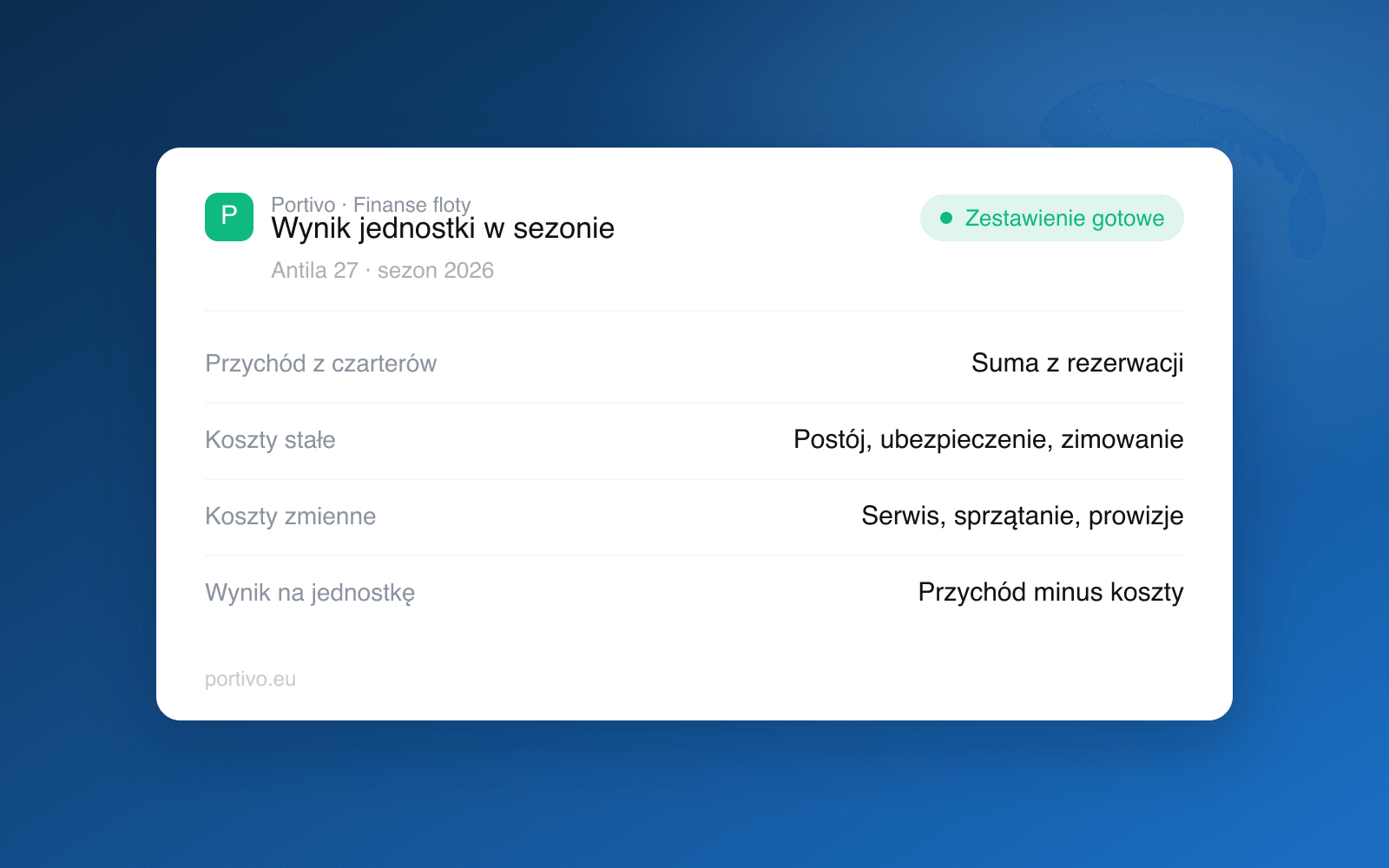
The method is simpler than it looks and does not require an accountant. Take the revenue generated by a specific boat over the season, subtract the fixed costs assigned to it alone and the variable costs incurred on its charters. What remains is that boat's result. The difficulty is not the arithmetic but the data: revenue has to be tied to a specific boat rather than to one big "season 2026" bucket, and workshop invoices have to name the boat. If you run bookings in a spreadsheet, this is usually where the process falls apart, which we cover in our guide to moving from Excel to a booking system.
The second metric worth tracking is the cost of a single charter day: the boat's total annual costs divided by the number of days you actually sold. That number tells you directly the rate below which it makes no sense to go, even in an off-season promotion.
Hidden costs that never show up on an invoice
Three items regularly slip out of the calculation. The first is the gap between charters: a day spent cleaning and servicing is a day the boat does not earn, while fixed costs keep running. How to shorten that window is covered in our guide to preparing a yacht between charters. The second is external channel commission, which at a high share of aggregator sales can eat the entire difference between a profitable boat and a loss-making one. The third is your own time: the owner's hours spent on phone calls, issuing quotes and chasing payments rarely make it into the calculation, even though they are a real cost to the business.
The most common mistake in profitability maths: comparing the daily rate against costs while ignoring the number of empty days. A boat with a great rate and weak utilisation loses to a cheaper boat that sails all summer.
What actually improves a boat's result
Three levers work faster than cutting costs. The first is utilisation: every extra day sold spreads the fixed costs wider, and we describe how to measure and raise fleet utilisation in our guide to charter fleet utilisation. The second is rates matched to the season instead of one price all year, the approach set out in our guide to dynamic pricing in charter. The third is add-on services sold at booking, because their margin lands on the same boat without raising fixed costs: we list them in our guide to add-on services in charter. If you are considering growing the fleet without buying boats, the alternative is the managed-boat model described in our guide to putting a yacht into charter management.
Frequently asked questions
How much does it cost to run a charter yacht per year?
There is no single rate: the cost depends on the boat's length, the region, the marina standard and how intensively it is used. The practical approach is to add up your own four fixed items (berth, insurance, winter storage, servicing) and divide the total by the number of days sold.
Is a boat used in charter more expensive to run than a private one?
Usually yes, because it sails many more hours in a season, which means more frequent surveys, faster wear on gear and a higher insurance premium for commercial use. In exchange it generates revenue that a private boat does not.
How do I assign shared costs to a specific boat?
Directly attributable costs (that boat's berth, policy and servicing) are booked straight to it. Shared costs such as team wages or marketing should be split by a simple key, for example the number of days sold, and you should keep the same key for the whole season.
Is it worth keeping a boat that barely breaks even?
Sometimes yes, if it completes your offer in a segment you would otherwise miss and pulls customers towards the other boats. Make that call after the season, based on data about its utilisation and result, rather than on an impression from July.
How much does a system that shows the result per boat cost?
Pricing depends on fleet size and is confirmed at a meeting, so you will find the details on our pricing page or we can settle them in a conversation.
Want to see which boat actually earns? See how Portivo's booking and finance module works, check pricing that depends on fleet size or book a meeting.