Charter add-on services: bedding, cleaning and gear without chaos on the dock
Charter add-ons can add a double-digit percentage to the bill. How to price them, when to collect payment and how to sell extras mid-charter without chasing transfers.
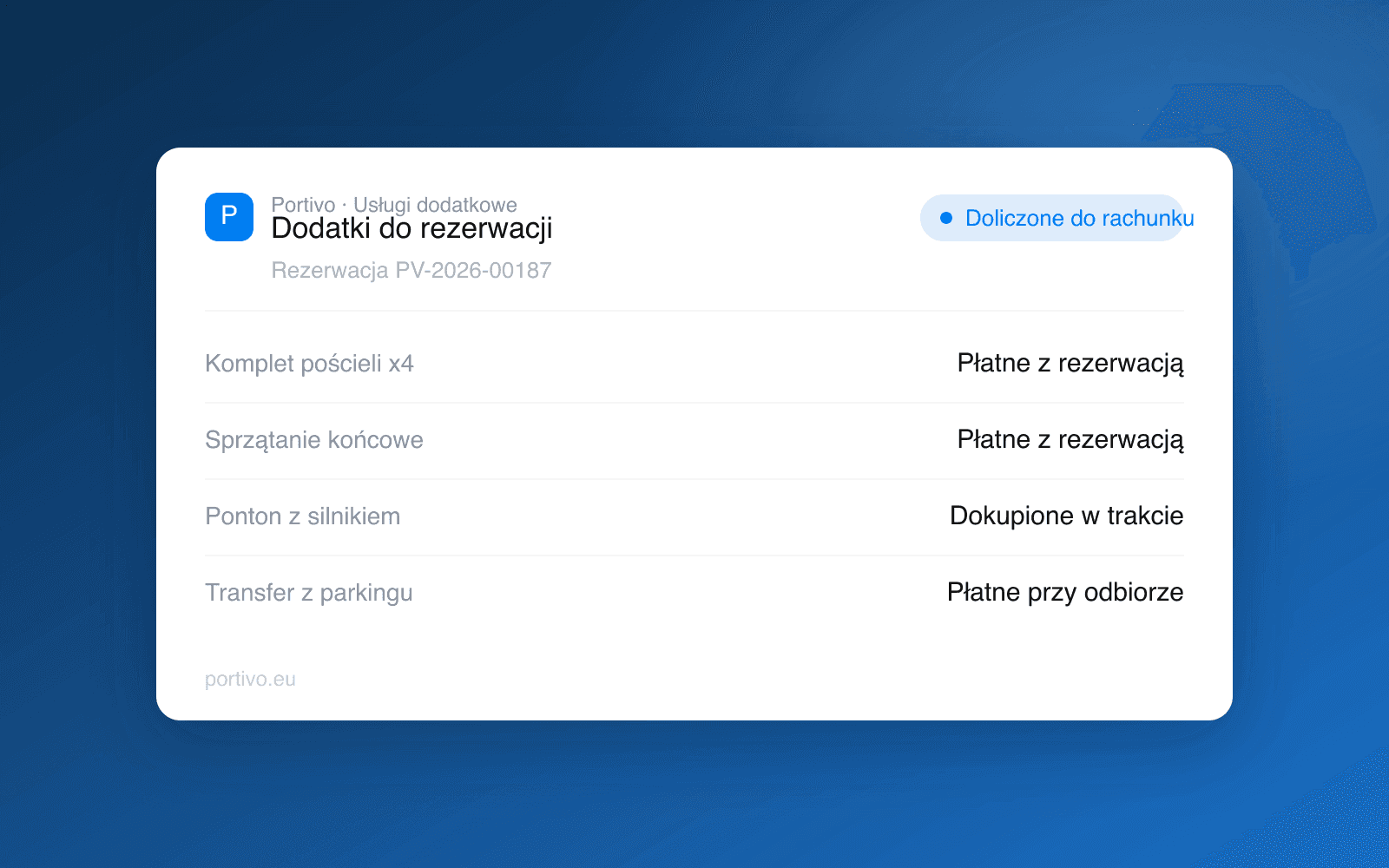
Bedding, final cleaning, a dinghy with an outboard, a transfer from the car park, a skipper for two days. Add-on services usually account for several to a dozen or so percent of a charter booking, and at the same time they are the most common source of misunderstandings at handover. This article shows how to organise your add-on catalogue, when to collect payment for it and how to sell extras during the charter, so it does not end with counting cash on the dock.
What operators most often sell as add-ons
The market is fairly repeatable here. The ranges below are observed market rates on Polish waters, not Portivo pricing: they depend on the boat, the region, the season and the operator.
| Add-on | Typical market range | Usually paid |
|---|---|---|
| Bedding set (per person) | approx. PLN 40-80 | with the booking |
| Final cleaning | approx. PLN 150-300 | mandatory, with the booking |
| Dinghy with an outboard | approx. PLN 100-200 per day | with the booking or as an extra |
| Skipper | approx. PLN 300-500 per day | with the booking |
| Handover in a different port | approx. PLN 200-400 | with the booking |
| Parking during the trip | approx. PLN 10-25 per day | at handover |
Two things matter more than the amounts themselves. First: an add-on should have one visible price on your website instead of being negotiated by email. Second: the customer has to know what is included in the charter price and what comes on top. A hidden cleaning fee discovered at handover costs more than it earns, because it comes back as a bad review.
Three ways to settle add-ons
Three models work in practice, and it pays to consciously assign every add-on to one of them.
| Model | How it works | Best for |
|---|---|---|
| Included in the charter | built into the daily rate, no separate line | standard equipment, simple communication |
| Paid with the booking | the customer picks it while booking and pays with the deposit or balance | bedding, cleaning, skipper, dinghy |
| Paid at handover | settled on site, based on actual usage | fuel, parking, extra hours |
The operators who sell the most are the ones who moved as many items as possible into the "paid with the booking" model. The customer decides at the moment of highest buying intent, that is while choosing the boat, not on departure day when the budget is under scrutiny. How to split the payment into a deposit and a balance is covered in our article on charter payment policies.
Add-ons bought during the charter
Extras are a separate category: the customer is already on the water and wants one more day, a dinghy or extra cleaning. The classic scenario is a phone call, an agreed amount and a transfer "sometime after the trip" that you then have to chase.
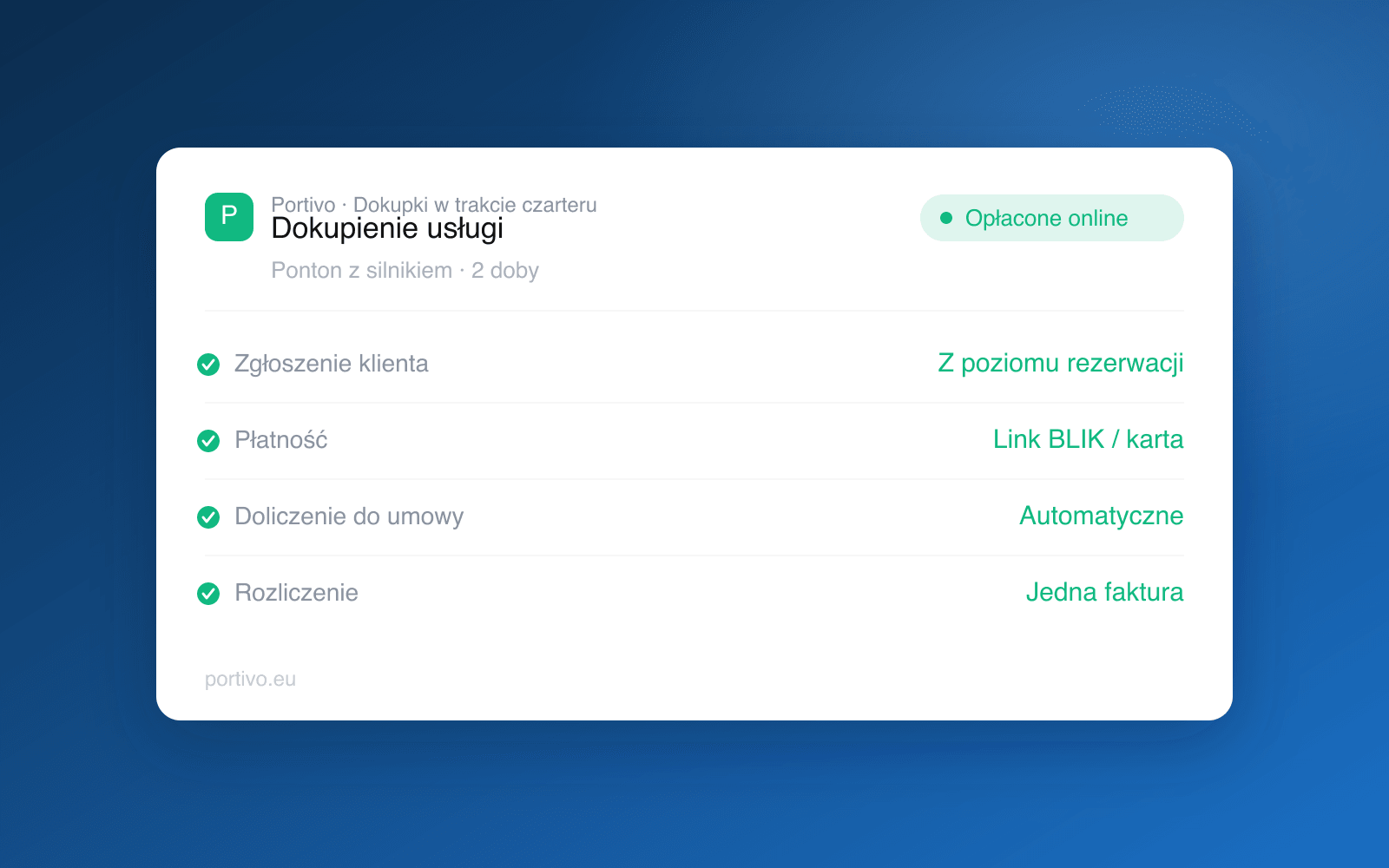
In Portivo an extra is a separate line item pinned to an existing booking and paid online with the same methods as the rest (card, BLIK, Przelewy24, bank transfer, and cash at handover). As a result, at the end of the charter you have one settlement instead of three channels: a transfer, cash and a promise.
An add-on that is not in the contract and not in the settlement effectively does not exist in a dispute. Every extra should leave a trace: a line item, an amount and a payment status.
Add-ons versus the deposit and the handover report
A common mistake is mixing add-ons with the security deposit. The deposit secures damage and goes back to the customer, an add-on is a sold service that does not. When one covers the other ("the deposit will cover the cleaning"), the refund conversation gets tense. How to set the deposit itself is explained in our article on the charter security deposit.
The same goes for the handover report: if you sell cleaning, the condition of the boat on return should be documented with photos. It is exactly the logic we describe in the article on the yacht handover report: one record, two parties, zero arguing from memory.
How to build an add-on catalogue that sells itself
- Keep the list to 6-10 items. A longer list lowers conversion and stretches the handover.
- Name the benefit, not the warehouse. "Bedding set, made up on the berth" works better than "bedding 1 set".
- Set a clear billing unit: per trip, per day, per person. A missing unit is a guaranteed complaint.
- Pre-select only what is mandatory. The rest should be the customer's choice.
- Track what actually sells. An add-on bought by fewer than one in ten customers needs either a different price or a different name.
Add-ons are also the simplest way to raise the average booking value without raising the daily rate, that is without dropping out of price comparisons. If you want a wider view of the whole charter sales process, start with our guide to charter fleet management, and closing deals is covered in the article on quoting in a charter business.
What it costs on the system side
In Portivo, add-ons are part of the bookings and payments modules, not a separate product. Pricing depends on fleet size and is confirmed at a meeting, so you will find the details on the pricing page and during a conversation with us.
Frequently asked questions
Should add-ons be mandatory or optional?
Make mandatory only what truly cannot be skipped (usually the final cleaning). Leave the rest optional: higher conversion and fewer disputes at handover.
How do I settle an add-on bought during the charter?
The simplest way is a separate line item pinned to the existing booking and paid online through a link. The customer pays immediately and you keep one shared charter settlement instead of several channels.
Do add-ons come out of the security deposit?
No. The deposit secures potential damage and returns to the customer, while an add-on is a sold service. Mixing the two makes settlement harder and erodes trust.
Do add-ons have to be listed in the contract?
Yes. The contract and the settlement should list every paid item with its price and unit. What else belongs in it is covered in our article on the charter contract.