Tax and accounting in a charter business: VAT, lump sum and sales records
How to account for boat rental: the VAT rate, forms of taxation, cash registers and sales records during the season. A practical overview for charter operators.
Boat rental is an ordinary service, so there is no magic in it from a tax perspective: there is a VAT rate, a form of income taxation and an obligation to document sales. The problem lies elsewhere: in charter, all sales happen within three months, payments arrive through five channels, and some customers are businesses while others are consumers. This article sorts out what you need to handle and how to set it up so that you are not reconstructing revenue from memory after the season.
This is informational material, not tax advice. Service classification, the right to a specific rate and record-keeping obligations depend on your situation. Confirm the details with your accountant, and in doubtful cases apply for an individual tax ruling.
VAT: renting out a boat
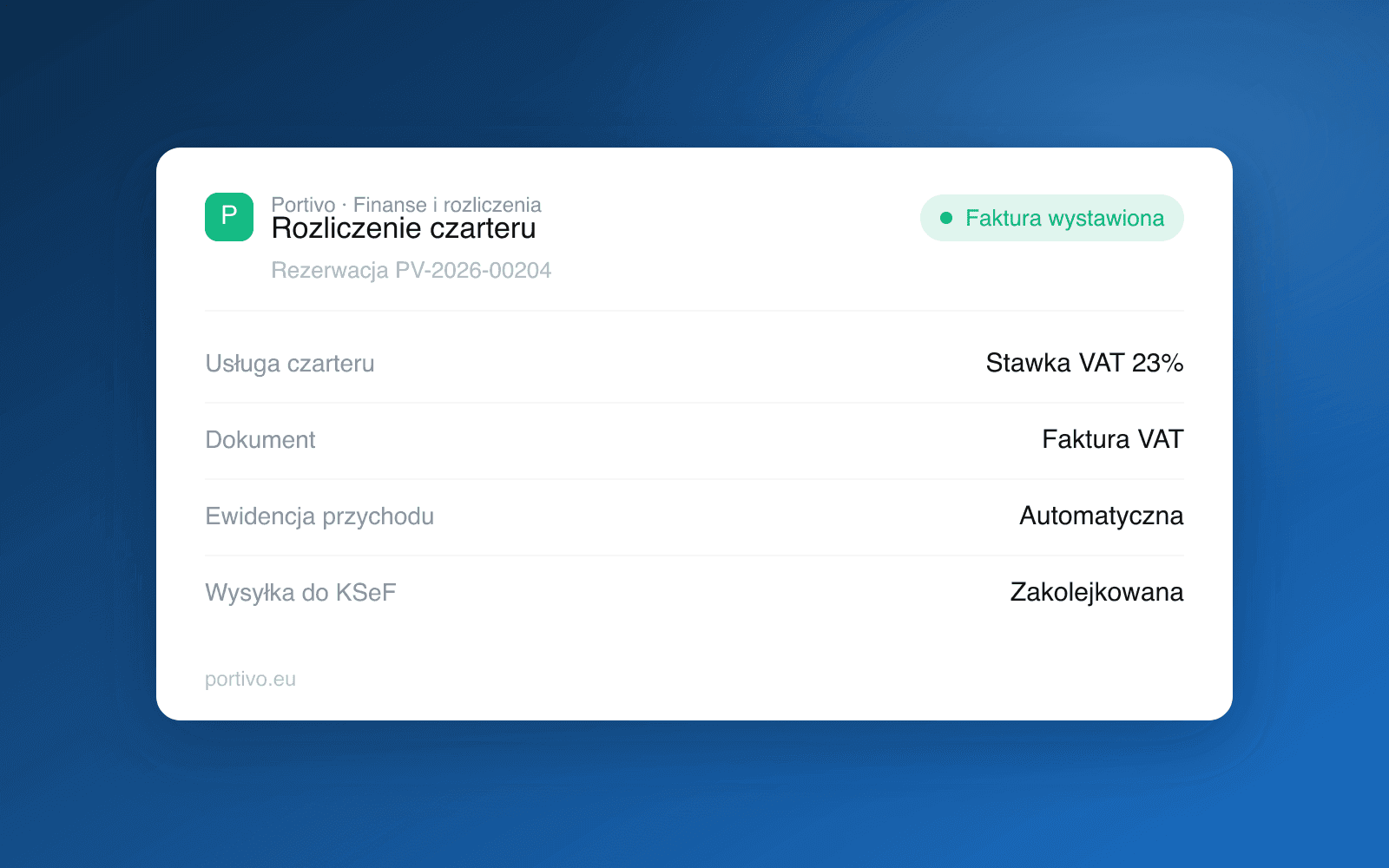
Renting a yacht or a boat in Poland is taxed at the standard VAT rate of 23%. There is no "tourism" preference here: reduced rates apply to other services, and a charter is the rental of a means of water transport.
The place of supply is a separate matter. For the rental of means of transport, the rules look, among other things, at where the boat is actually put at the customer's disposal and at whether the customer is a taxable person. As long as you hand the boat over in a Polish port to a Polish customer, it is straightforward. With foreign customers or handover outside Poland it is worth working it through with your accountant before issuing the invoice.
Form of income taxation
| Form | When it is usually considered | What to watch out for |
|---|---|---|
| Tax scale | small scale, many costs (servicing, mooring, insurance) | thresholds and the health contribution |
| Flat tax | higher income, many costs | no joint filing and no reliefs |
| Registered lump sum | few costs, a simple rental model | the rate depends on service classification |
With the lump sum, classification is key: renting out means of water transport without a crew (without a skipper) is sometimes settled at 8.5%, while the tax authorities treat this category inconsistently, and part of the rulings apply a 12.5% rate to the rental of business assets above PLN 100,000 of revenue. If your offer also includes skippered charters, the service may be classified differently from a bareboat rental, which we cover from the customer's side in our article on skippered charters. This is exactly the point where an individual ruling costs less than a three-year correction.
Documenting sales and the cash register
A business customer gets an invoice. A private customer, as a rule, gets a receipt from a cash register, unless you use an exemption (most often invoked for fully cashless payments, where the records and documents clearly show which transaction the payment relates to). This is one of the reasons why moving deposits and balances into online payments makes life easier: every payment has its trace, amount and booking.
On top of that comes e-invoicing in KSeF, which changes how invoices are issued and stored. What it means operationally for a charter company is spelled out in our article on KSeF and GDPR in a charter business.
Advance payments, deposits and the moment revenue arises
This is the most common source of errors in charter, because the money arrives in a different month than the service.
- Advance payments and booking deposits are payments towards a future service. In VAT, the tax obligation generally arises when the payment is received, so a December advance for a July charter belongs to December.
- The security deposit is refundable security, not revenue. As long as you return it, it is not a sale. Keeping part of it to cover damage requires a separate settlement. The mechanics are covered in our article on the charter security deposit.
- Add-ons (bedding, cleaning, a dinghy) are sold services and go into the taxable base together with the charter. Details in our article on charter add-on services.
- Customer cancellation: a retained booking deposit has a different character from payment for a service, and this affects how it is documented. Refund rules are covered in our article on cancelling a charter booking.
Sales records during the season
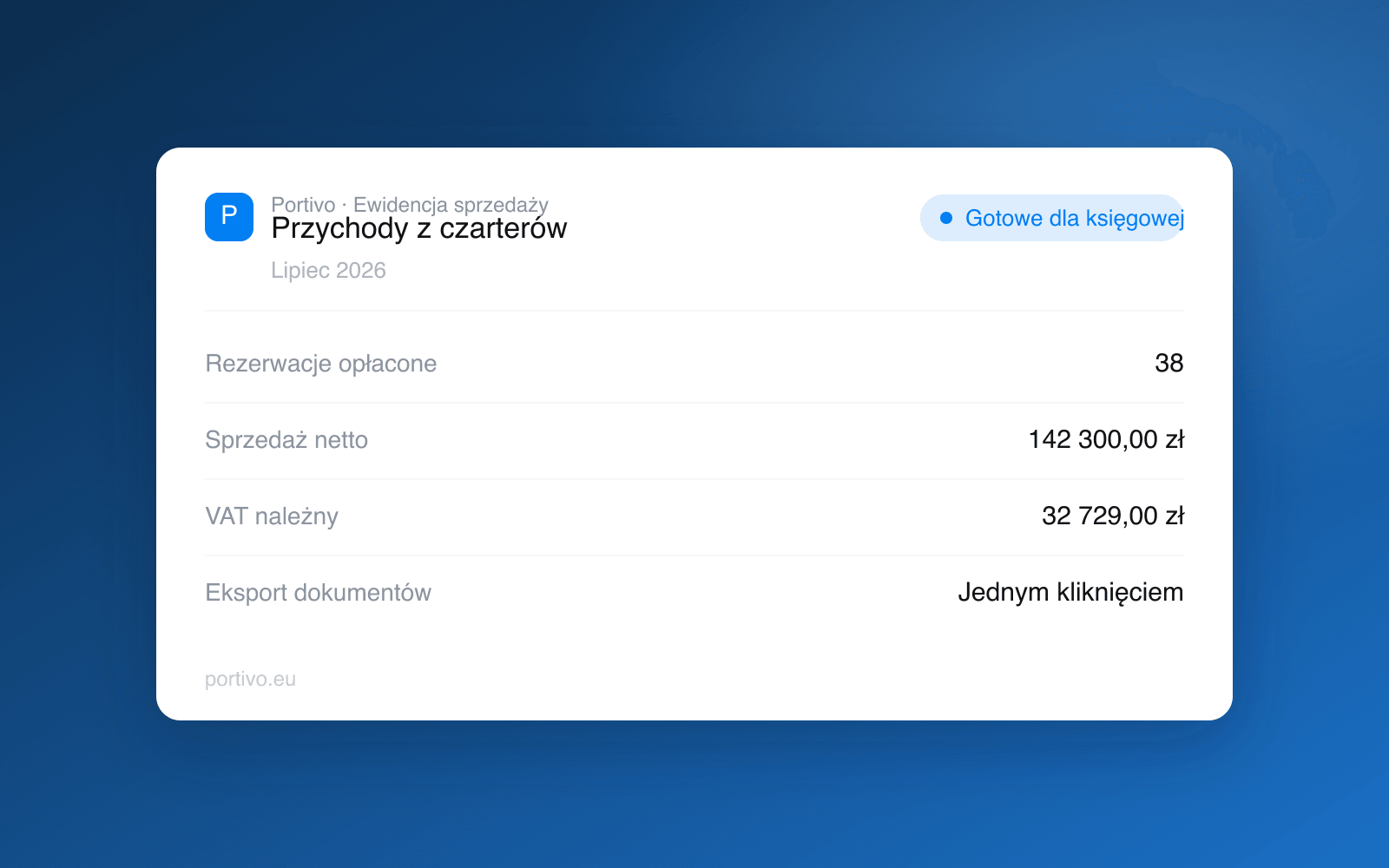
The biggest accounting cost in charter is not the tax itself but the time spent consolidating data: bank transfers, card payments, BLIK, Przelewy24 and cash at handover, plus last year's advances and this year's balances. If sales run through one booking and payments system, every item has a booking, a date and a status, and the monthly summary stops being a weekend project. It is the same principle we describe in our article on booking automation: one source of truth instead of five channels.
A short checklist before the season
- Settle your form of taxation and confirm the classification of your services with your accountant.
- Check the cash register obligation for sales to private individuals and the conditions of any exemption.
- Set consistent names for sales items: charter, add-ons, security deposit. Never book the deposit as a sale.
- Move deposits and balances into online payments so that every payment is tied to a booking.
- Prepare for e-invoicing in KSeF and check whether your system sends invoices automatically.
The whole sales process, from enquiry to invoice, is covered in our guide to charter fleet management. If you want to see how this looks in Portivo for your fleet, pricing depends on its size and is confirmed at a meeting, so visit the pricing page or book a call.
Frequently asked questions
What VAT rate applies to yacht charter in Poland?
The standard one, 23%. Renting a boat is the rental of a means of water transport, not a service covered by a reduced rate.
Can boat rental be settled with the registered lump sum?
It is sometimes settled at 8.5% for bareboat rental, but the classification is disputed, and a 12.5% rate applies to the rental of business assets above PLN 100,000 of revenue. Confirm it with your accountant or an individual ruling before choosing a form.
Is a charter security deposit revenue?
No, as long as it is refundable. It becomes revenue only in the amount retained to cover damage, and that then requires separate documentation.
When does the tax obligation arise on a charter advance payment?
In VAT, usually when the payment is received, not on the charter start date. That is why autumn advances for the next season are settled in the month they are paid.